I estimate that I have delivered over 500 platform presentations throughout my career. From groups eager to learn about products (the toughest audience – they expect a boring, fact-heavy presentation) to my years serving on the board of a national association and a consumer education foundation, I’ve learned a few things. Having learned the hard way, I want to help you avoid my mistakes and benefit from my long-term education. So, class… let’s get started.
Imagine this: You’re sitting in a dimly lit conference room, the lights flickering slightly as the projector hums to life. The speaker, a well-meaning executive in a sharp suit, clicks to the first slide. You brace yourself. The screen fills with charts, numbers, and bullet points. He speaks earnestly about “Q3 metrics” and “market differentials,” his laser pointer nervously darting across the graph.
You want to care, but your mind drifts. The data is dense. The message becomes unclear. Within minutes, everyone checks out. Some scroll through their phones, others stare politely but blankly, and the rest look for the coffee station or check their meeting app to see when this session ends.
Now, picture a different presenter. She approaches the same lectern but starts with a story. “Last year, one of our clients nearly shut down. Their return backlog doubled, and employees grew frustrated. But then something unexpected happened…”
You lean in, eager to see what happens next. She guides you through the struggle, the turning point, and the outcome. Along the way, she adds data, not as the main focus but as seasoning that gives her story depth. When she finishes, the audience isn’t just informed, they’re inspired.
Same room. Same audience. Same goal.
Yet, two entirely different results. Which speaker had a greater impact? We already know the answer.
You need to capture their attention!
There are many effective ways to start a presentation. The same advice and techniques apply whether you’re speaking on stage to a large crowd or just on a Brady Bunch screen with your colleagues; you need to grab their attention if you want your message to resonate.
Begin with two seconds of silence to focus on your audience. You can conduct a “show of hands” exercise, ensuring it’s relevant, and then use it to engage and build immediate rapport. Tell an on-topic joke. Though risky, it can be effective. Share an impressive statistic, pause for a few seconds, then repeat it to help your audience follow along.
But there’s an even better approach: tell a story.
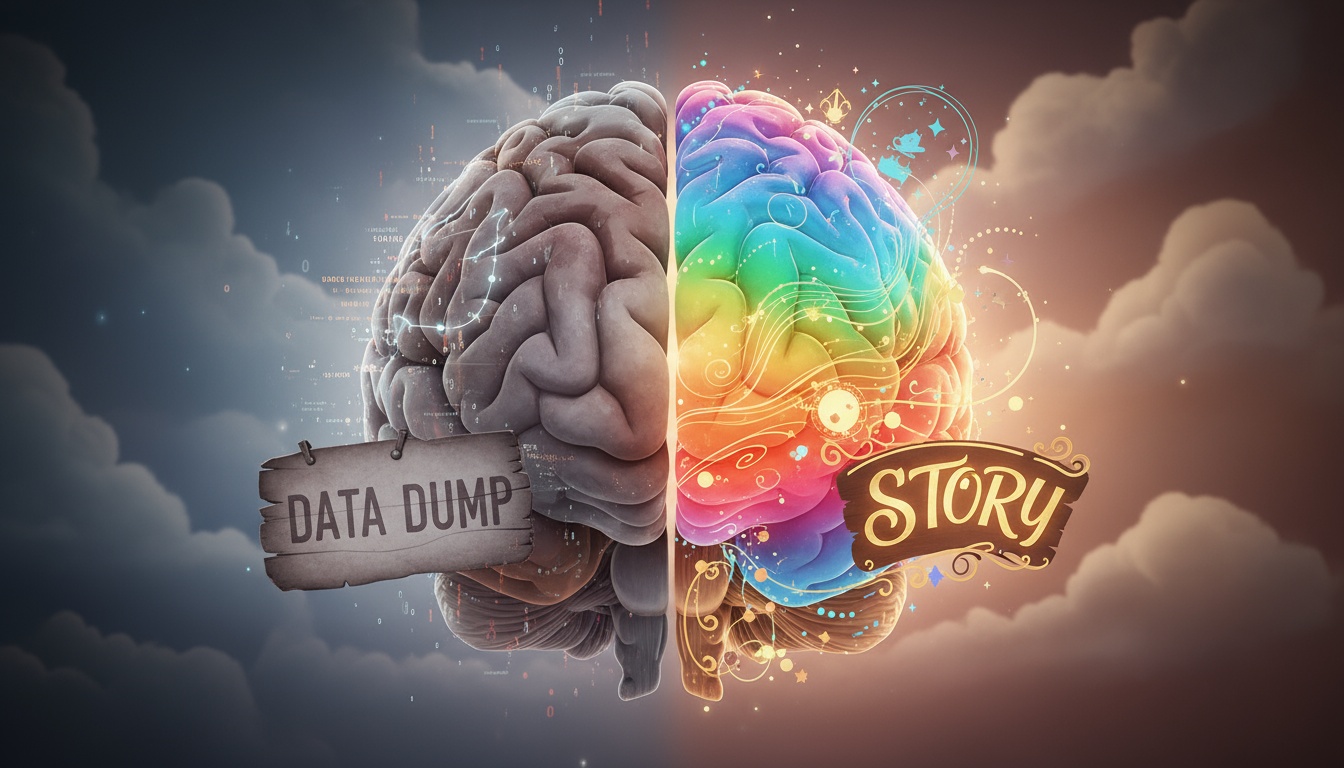
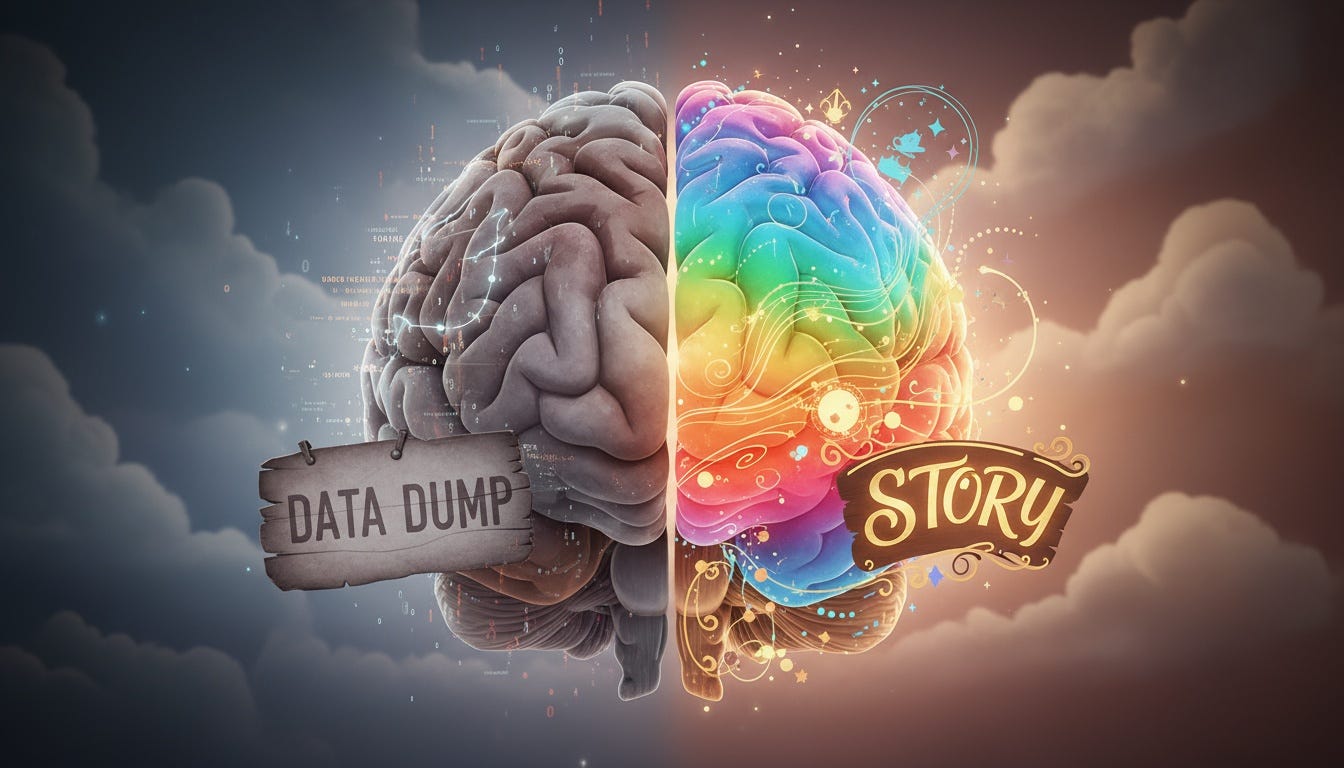
Our brains aren’t wired to process lists of information; they’re built to experience stories. When we hear data, only the brain’s language centers activate. But when we hear a story, something remarkable occurs: the brain lights up in many areas. The sensory cortex, motor cortex, and emotional centers all activate as if we’re living it ourselves.
That’s why a good story doesn’t just explain, it pulls you in. The listener’s brain syncs with the storyteller’s during a process neuroscientists call “neural coupling.” It’s empathy in motion. For a few moments, your audience isn’t just hearing your point; they’re feeling it.
The Power of Emotion
We often believe people make decisions based on facts and logic. In reality, emotion causes understanding to turn into action. The limbic system, the emotional center of the brain, guides most human choices. Story is how we connect with it.
When we describe a challenge, introduce tension, and resolve it, we trigger the release of neurotransmitters such as dopamine and oxytocin. Dopamine boosts attention and memory; oxytocin fosters trust and connection. That’s why people remember stories long after they’ve forgotten statistics. A good story literally rewires the listener’s brain to care.
The Difference Between Communication and Connection
A well-structured story has a natural flow, comprising a beginning, conflict, and resolution. This pattern reflects how the human brain processes information. We seek patterns that help us understand complex ideas. When you organize your ideas into a story, the audience can follow a clear path and has a reason to stay engaged.
On the other hand, a flood of data without context leads to cognitive overload. The brain shuts down what it can’t process. Stories bring order to chaos.
The first speaker shared facts with their audience. The second invited them into an experience. That’s the key difference between communication and connection. When we tell a story that feels authentic, the audience sees themselves in it. That’s where influence begins.
The Takeaway
Storytelling isn’t just about making your presentation more engaging — it’s about connecting with how people think, feel, and remember. Data can support your point, but a story gives it meaning.
Before your next meeting, keynote, or conversation, ask yourself: am I sharing information, or am I telling a story that inspires action? Because if all you do is present facts, slides, and bullet points, your audience may hear you… But they won’t feel you.
And if they can’t feel you, they won’t follow you. Without a story, you’re on mute.
Free 30-minute marketing discovery call
Schedule a 30-minute discovery call to learn about our exclusive
savings offer for Substack subscribers.
One More Thing
For you TL;DR folks (you know who you are), check out our YouTube Snarky Summaries. (please LIKE and SUBSCRIBE)