Why companies hedge, qualify, and talk around the very thing they need to say
This is the sixth column in our ten-part series, “Why Companies Do This to Themselves.” We’ve explored how reasonable decisions create unreasonable buying experiences, how expertise makes explanation harder, why customers haven’t completed your prerequisite coursework, how the view from inside the building distorts reality, and how consensus turns clear messages into corporate oatmeal. Which brings us to an uncomfortable possibility: Sometimes the company knows exactly what it needs to say. It understands the customer’s problem. It has a useful answer. Someone has even written a sentence that connects the two. Then everybody looks at that sentence and starts getting nervous, because saying something clearly means somebody might hold you to it.
A Clear Sentence Leaves Fingerprints
A specific statement makes a company visible in ways that broad language does not. It identifies whom you serve, what you help them accomplish, and what they can reasonably expect. That gives a prospective customer something useful to evaluate. It also gives everyone inside the company something concrete to worry about. What if someone wants something slightly different? What if a competitor challenges us? What about the unusual project from three years ago? Could we soften that a little?
Soon, “We help independent retailers know what to reorder before they run out” becomes “Our adaptable capabilities can support a range of inventory-related objectives.” The company has successfully reduced the likelihood that anyone will dispute the statement. It has also reduced the likelihood that anyone will care. Last week’s corporate oatmeal came from making room for everybody’s contribution. This week’s problem comes from making sure nobody feels exposed. The sentence gets weaker because people understand its implications perfectly well.
The Kitchen Nobody Will Promise
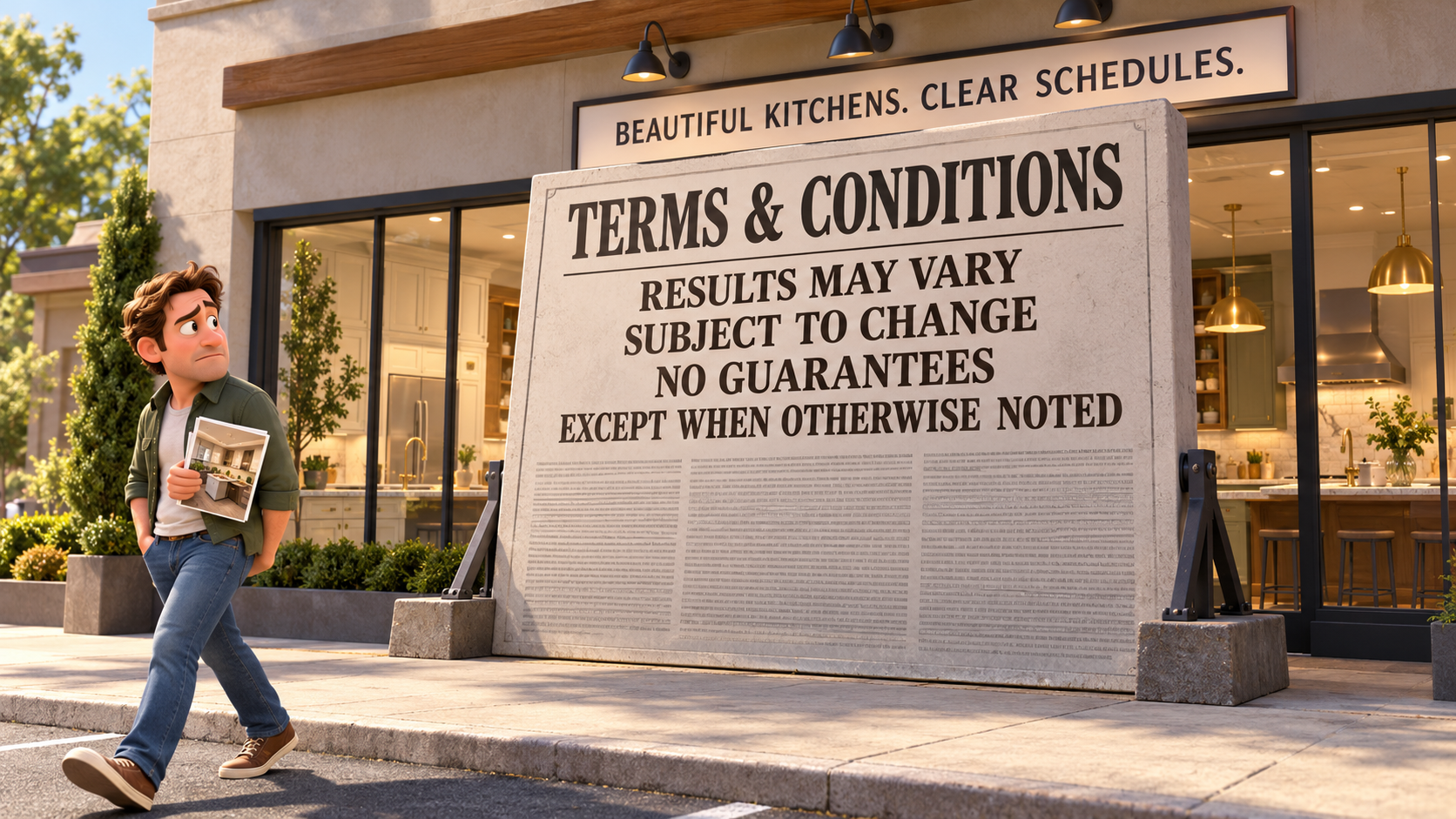
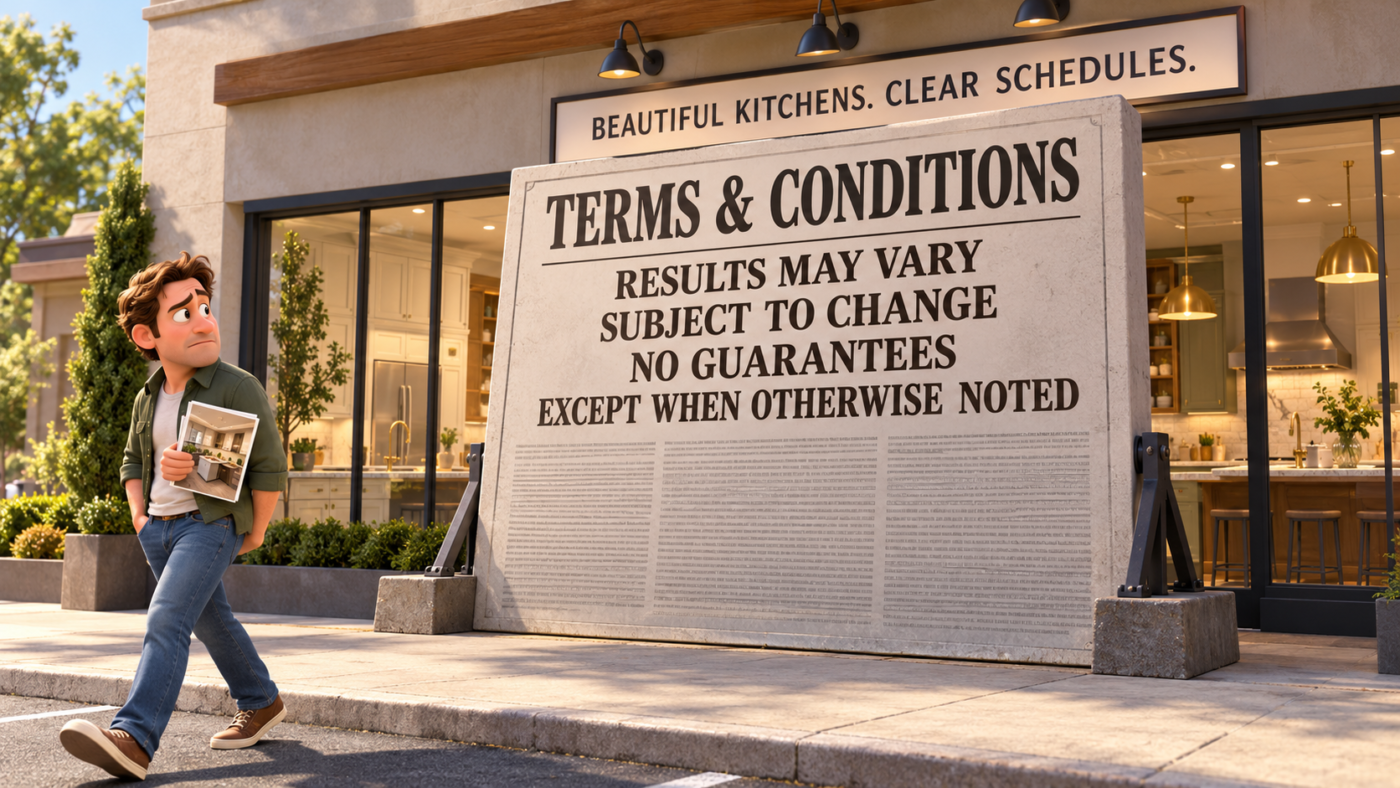
Imagine a fictional remodeling company that specializes in replacing kitchens while homeowners remain in the house. Its team has developed a dependable process: a written construction schedule, dust barriers, daily cleanup, and one person responsible for answering questions. The initial website copy says, “A new kitchen, with a clear schedule and someone who answers the phone.” That speaks to recognizable anxieties. Homeowners worry about weeks of disruption, disappearing contractors, and eating dinner beside a refrigerator in the living room. The sentence gives them a reason to investigate.
Then the qualifying begins. Schedules sometimes change. The project manager cannot answer every call immediately. “Clear” might mean different things to different people. Someone suggests “We strive to provide.” Someone else prefers “Our goal is.” Eventually, the headline announces, “A commitment to facilitating positive remodeling experiences through responsive project coordination.” The kitchen still gets built. The company still does good work. But the homeowner can no longer see why hiring it might feel different.
A more useful revision would preserve the benefit and explain the process: “Know what happens next in your kitchen remodel. Get a written schedule, weekly updates, and a named project manager.” Necessary limitations can be explained where they help the homeowner understand the agreement. They do not need to swallow the introduction. The company can acknowledge that construction involves uncertainty while still explaining how its process helps homeowners manage it.
Why Your Brain Likes an Escape Hatch
There is a psychological reason that a vague sentence can feel more comfortable than a clear one. Clear statements invite evaluation. People can judge whether you were right, whether you delivered, and whether your recommendation was any good. At work, those judgments can affect your reputation and standing. That discomfort has a physiological dimension. In a 2004 review of 208 laboratory studies, psychologists Sally Dickerson and Margaret Kemeny found that performance tasks involving social evaluation or uncontrollability could elicit cortisol responses. The possibility of being negatively judged can engage the body’s stress response.
Those experiments did not study website headlines. They do, however, help explain why exposure to judgment can feel threatening. Applying that insight to a messaging meeting, a qualification offers an appealing escape hatch: If the statement says less, perhaps less can come back to haunt its author. The organizational incentives can reinforce that instinct. An executive’s objection arrives immediately, with a name attached. The prospect who leaves because the message explains nothing usually departs silently. One consequence is personal and visible. The other becomes a disappointing number in next month’s report.
When Caution Becomes the House Style
Amy Edmondson’s research offers another useful lens. Her 1999 study of 51 manufacturing work teams found an association between psychological safety—the shared belief that interpersonal risks are safe within a team—and learning behavior. People’s expectations about what happens when they speak up matter. For messaging, that suggests looking beyond the writer. What happened the last time someone recommended a direct statement? Did leadership examine the evidence, or did someone get embarrassed for overlooking an exception? Does raising a concern improve the promise, or automatically erase it?
Employees learn the house style. If specificity earns interrogation while abstraction earns approval, abstraction will flourish. Before long, nobody needs to demand weaker language. The first draft arrives wearing protective padding. Telling that team to “be bolder” will accomplish very little unless leadership changes what happens when someone tries. People need evidence that a thoughtful, supportable statement will receive a fair hearing, even when it makes someone in the room uncomfortable.
Accuracy Needs Backbone, Too
Some qualifications are essential. A company should explain meaningful restrictions, disclose uncertainty, and avoid promises it cannot support. Courage does not require pretending that exceptions do not exist. The useful question is what each qualification helps the customer understand. Does it explain a real condition affecting the purchase? Or does it mainly help someone inside feel less accountable for making a statement? “We typically complete installation in two days after materials arrive” gives a buyer something useful, provided the company can substantiate it. “We endeavor to facilitate timely installation outcomes” supplies an ambition dressed as information.
Specificity can actually improve honesty. It forces the company to define what it means and examine whether it can deliver. If the team cannot support the claim, it has discovered an operational problem worth fixing. Replacing the claim with fog merely postpones that conversation. Meanwhile, the customer still needs an answer and may find another company willing to give one.
Say the Thing You Can Stand Behind
Start by asking the team to write the sentence it keeps talking around. Who is this for? What problem do we solve? What can we reasonably promise? Then examine the evidence and the genuine limitations before polishing the language. When someone proposes a hedge, ask what specific misunderstanding it prevents. If there is a real issue, address it precisely. If the concern is a remote exception, decide where that exception belongs without making every prospect climb over it first.
Leadership has to support this work. A defensible statement needs someone willing to approve it, deliver on it, and revise it when evidence changes. Otherwise, caution will keep editing until the message can survive anything except contact with a customer. Your prospect needs enough substance to decide whether a conversation is worth having. Give them a promise they can understand and you can support. If you keep qualifying your message until there is nothing left for a customer to recognize, believe, or act on, You’re on mute.
TL:DR? Watch our 3-minute summary on YouTube: https://youtu.be/w3kIE-LRsR4
Production note: AI assisted in developing this article and creating its illustrative graphics under my direction. The ideas, perspective, and final editorial decisions are mine.