

The Problem with Talking First
Let’s be blunt: if you’re doing all the talking in a sales conversation, you’re doing it wrong.
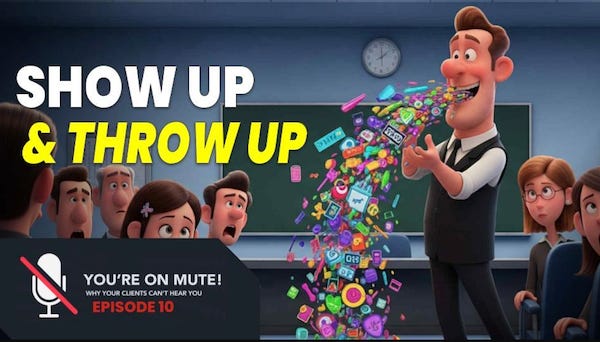
In the rush to impress, persuade, or close the deal, many professionals fall into the trap of what’s lovingly called “show up and throw up.” It’s not as gross as it sounds—unless you’re on the receiving end. This phrase describes the common sales mistake of walking into a conversation and immediately unloading every feature, spec, and benefit on the table as if you’re trying to win a Guinness World Record for Most Words in a Meeting.
Instead of fostering connection, this creates confusion. Instead of encouraging engagement, you get silence. It’s like giving someone a firehose when they just asked for a sip of water.
What “Show Up and Throw Up” Really Means
Imagine this: a salesperson walks into a room, launches into a 20-minute monologue, and never pauses to ask a single question. Or you land on a website so cluttered with jargon, bullet points, and hype that you forget why you were even interested.
This is classic “show up and throw up.” It’s what occurs when a company leads with their product rather than the customer’s problem. It’s a one-sided performance masquerading as a conversation.
As Marcus Sheridan reminds us in They Ask, You Answer, if you don’t show it, it doesn’t exist. And if you overshow it, it might as well not exist either, because nobody’s paying attention anymore.
Why Dumping Features Doesn’t Work
You might believe that listing every benefit of your product or service demonstrates intelligence and thorough preparation. But here’s the truth: nobody wants to hear everything. They want to hear what matters—to them.
1. It Overwhelms People
When you present an overwhelming amount of information, you trigger what psychologists call “decision fatigue.” Too many choices and excessive data paralyze people. They tune out, postpone decisions, or completely ignore you.
2. It Ignores Their Story
Donald Miller’s StoryBrand framework (based on thousands-of-years-old Story Theory) teaches that your customer is the hero—not your product. If you talk nonstop, you’re taking the hero’s place. That’s not your role. Your role is to be the guide, the Yoda, the Dumbledore. Heroes don’t need a lecture—they need assistance on their journey.
3. It Undermines Trust
Modern buyers are skeptical. Research shows that 70% of the buying decision is made before a prospect even reaches out. So, when they finally talk to you, they’re looking for clarity, not noise. If you’re dodging real questions like pricing or comparisons and just rattling off features, you come across as evasive.
Flip the Script: Talk With, Not At
So how do you resolve this? It’s easy. Turn the conversation around. Instead of talking at people, converse with them.
1. Start with Their Needs
Don’t start with your product. Start with their problem. Ask questions like, “What’s holding you back right now?” or “What would success look like for you?” You’ll instantly learn more than you could ever assume.
2. Be Transparently Helpful
People value honesty. Address the difficult questions—like “How much does it cost?” or “What’s the downside?” Sheridan’s pool company famously published an article titled “How much does a pool cost?” and attracted over a million unique visitors. Why? Because they voiced the unspoken concerns. Do that, and people will trust you.
3. Use Clear, Story-Based Language
Forget features. Talk about outcomes. Instead of saying, “Our platform integrates with 14 systems,” say, “You’ll spend 10 fewer hours a week manually entering data.” That’s a story. That’s what people remember.
The 80/20 Rule for Client Conversations
Here’s a golden rule: 80% of the conversation should focus on the client, while only 20% should revolve around your product.
This balance shifts the dynamic, transforming you into a partner rather than merely a pitch machine.
A Quick Oversharing Checklist
Worried you’re still oversharing? Here’s a checklist to gut-check your messaging:
– Is the customer’s problem clear?
If not, start there.
– Are you focusing on one solution, not all of them?
Less is more.
– Is the language plain and simple?
No one’s impressed by buzzwords.
– Have you tackled the scary stuff?
Talk about pricing, drawbacks, or comparisons. If you don’t, Google will. And Google isn’t on your payroll.
– Do you have one clear call to action?
Not three. One.
– Can you say it all in 30 seconds?
If not, trim it.
Stop Performing. Start Guiding.
“Show up and throw up” is just bad manners in disguise. It’s loud, selfish, and unhelpful. You wouldn’t do it at a dinner party, so don’t do it in your marketing.
Both Marcus Sheridan and Donald Miller agree: the companies that win are those obsessed with their customers’ fears, questions, and desires. They listen, respond, and guide.
So, stop the monologue and start the conversation. When you do, you’ll stop sounding like a sales pitch and start sounding like the solution. And that, my friends, is the difference between being ignored and being indispensable.
Questions? Please email us at info@thesaltzmangroup.com
SCHEDULE a 30-minute discovery call.
One More Thing
Check out our 2-3 minute YouTube Snarky Summaries. (please LIKE and SUBSCRIBE)
Thanks for reading You’re On Mute. Subscribe for free (contributions gratefully accepted) to receive new posts and support my work.
Subscribed