Artificial Intelligence is the new gluten-free. Nobody truly understands what it means, but every product claims to have it. When it comes to creating clear, compelling messages, nothing conveys “personal connection” like a website that looks like it was written and designed by a caffeinated spreadsheet.
We aren’t Luddites, protesting against the rise of machines, and this isn’t 1779. Most of us have seen and adapted to what is inarguably the fastest rate of technological change in human history.
Just 25 years ago, at the turn of the century, smartphones hadn’t been invented. We were using flip phones with T9 messaging. If you wanted to watch a movie at home, you would either go to Blockbuster or wait for it to air on terrestrial TV. Social media, cloud storage, voice assistants, and AI tools weren’t available. Yelling “Alexa” followed by a question produced… nothing.
Moore’s Law Hits Warp Speed
In 1965, Gordon Moore (co-founder of Intel) said, “The number of transistors on a microchip doubles every two years while the cost of computing is halved.” This became known as “Moore’s Law” and essentially meant that computing power would increase exponentially while becoming cheaper and more efficient.” Today, Moore’s Law has become the understatement of all time.
We LOVE all this stuff. But (there’s always a but, right?) AI seems to have consumed the universe and spit us out whole. It appears to be taking over. Well… not yet. Even people like Sam Altman (he is Mr. ChatGPT) believe that the real future of AI involves humans working side-by-side with it.
Your message isn’t clearer because a robot wrote it; it’s just unclear faster.
This is especially important for creating clear messaging and compelling marketing. Until the singularity catches up with us, humans are still needed for strategy. Humans can read the room (both figuratively and literally). Machines can’t. They can be programmed to imitate humanness, but they still need us.
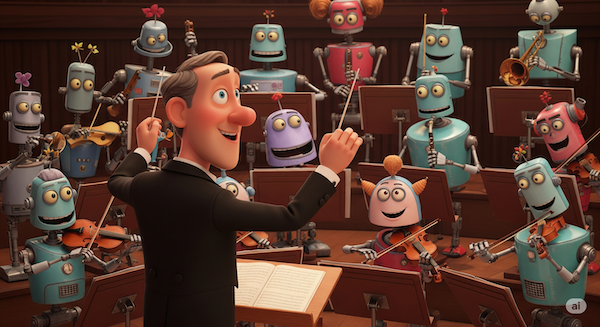
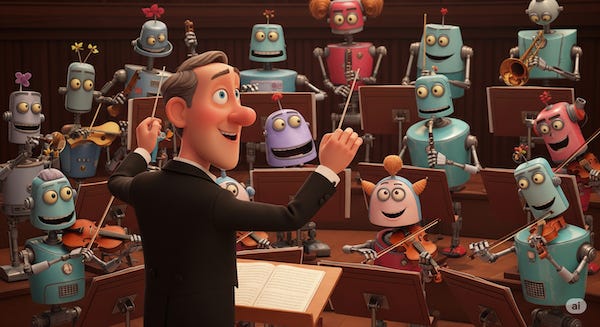
The New York Philharmonic orchestra has over a hundred of the inarguably finest, most talented, and highly-trained musicians in the world. Yet next season, celebrated Venezuelan conductor Gustavo Dudamel will be in front of those musicians, waving a small white stick. Why do players at this level need a conductor? For the same reason, artificial intelligence needs adult intelligence: to provide those things, the players themselves can’t.
The conductor sets the tempo, cues entrances, and synchronizes complex passages to prevent chaos, especially in intricate works like those of Stravinsky or Mahler. Your messaging needs to weave a compelling narrative. AI may assist with the parts, but you need a conductor. The conductor shapes the music’s artistic vision, provides leadership and communication, hears the entire orchestra and makes the necessary adjustments, and manages the scale of your “symphony”.
AI for Speed, Humans For Soul
The bottom line is: your marketing needs an adult at the table. Robots may be fast, but adults are smart. Speed only results in more of the same noise you’re trying to rise above. Being smart creates stories that resonate and inspire action because strategy isn’t just a spreadsheet filled with feelings.
The uber-nerds at MIT authored a position paper that supports this vision, promoting what they called “human-agent systems”. They mentioned that the “most promising future for AI is not in systems that take over human roles, but in those that enhance human capabilities through meaningful partnership.”
That kind of partnership means knowing where machines shine and where they stumble. Machines excel at pattern recognition, data processing, and repetitive tasks. Humans shine at intuition, nuance, irony, empathy, and knowing when to stop talking. You don’t need a machine to feel the gut punch of a missed opportunity or the quiet satisfaction of a job done right. That’s Adult Intelligence. That’s knowing your audience, understanding your client, and connecting with your market in ways that algorithms can’t simulate, no matter how many data points they digest.
Marketing is not just about transmitting information.
It’s about transferring feelings. It’s the art of saying something that makes someone else care. AI might generate a thousand taglines in a second. But it won’t know which one makes your customer lean forward, nod, and say, “That’s me.” It doesn’t know what your client dreamt about last night or what keeps them awake at 3:00 AM. It’s hard to imagine their childhood or how they feel when their boss walks into the room with a weird smile. These aren’t inefficiencies. These are the soul of storytelling.
If your strategy begins and ends with a prompt and a bot, don’t be surprised if your brand voice resembles a Google translation of a Zoom call from 2020. The best campaigns are founded on clarity and confidence, not convenience. Convenience helps, but it’s not a strategy. It’s tempting to outsource your thinking, but that’s how you end up sounding like everyone else, just faster.
Here’s the irony. All this incredible AI power—its countless variations, relentless productivity, and silicon-based confidence—still relies on you to determine what matters. What problem are you addressing? Why does it matter to the people you serve? And why now? These questions aren’t technical. They’re human. They come from experience, context, and the courage to care enough to ask them.
Use the tools. Embrace the innovation. But . . .
This is not a rant against progress. But don’t mistake tools for talent or speed for substance. AI is a calculator. You’re the accountant. AI is the keyboard. You’re the pianist. AI is the brush. You’re the painter. AI is the orchestra. You’re the conductor. You make it meaningful. You make it matter.
The market is filled with noise. Bots continue to generate endless content, visuals, and promises. Your advantage isn’t more content; it’s better content. It’s strategy with heart, stories with backbone, and messaging that resonates because someone—an adult—made sure it was rooted in the reality of human experience.
A fellow Certified StoryBrand Coach told me that she doubled her income in the first half of this year, solely by rewriting ineffective marketing copy written by AI. That is as real as it gets!
If your messaging lacks clarity, empathy, and direction, it’s not because you don’t have enough AI. It’s because you don’t have enough AI of the adult kind. And if you’re still letting the bots do all the work while your brand drifts aimlessly in the algorithmic soup, then… you’re on mute.
We turn muddled messages into magnetic marketing.
Discover how we can help you cut through the noise, reach the right customers, and keep your pipelines full.
SCHEDULE a 30-minute discovery call, and ask about our special offer for Substack subscribers.
One More Thing
Check out our 2-3 minute YouTube Snarky Summaries. (please LIKE and SUBSCRIBE)
Questions? Please email us at info@thesaltzmangroup.com
Thanks for reading You’re On Mute. Subscribe for free (contributions gratefully accepted) to receive new posts and support my work.