
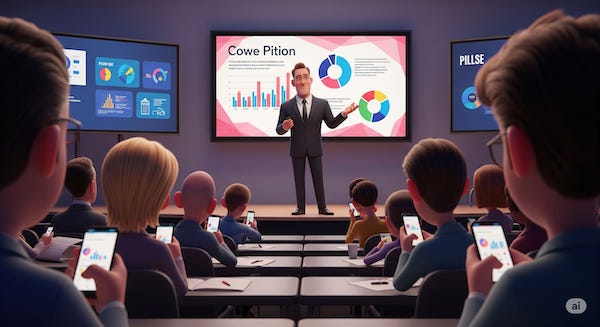
Last week, I sat through three different presentations in three very different settings. One was a main-stage presentation at a business meeting. The second was the unveiling of a new product. The third was a technology demo where a company hoped to partner with one of my clients.
On paper, these were high-stakes opportunities. The audiences were captive, the decks were polished, and the presenters were confident. Yet, in each case, the same quiet tragedy unfolded.
They never once told the audience why they should care.
That single omission torpedoed the entire effort.
Let’s walk through each one, then discuss what went wrong and, more importantly, how you can prevent the same mistake.
Incident 1: The Stage Presentation
A charismatic speaker took the stage at a popular industry event. She started with a personal story, delivered it with great timing and charm. Her slides were clear and professional. Her speech was rehearsed but still felt natural and friendly. The audience even responded with a laugh or two.
But as the minutes went on, something strange happened. People stopped taking notes. Phones appeared. Eyes drifted toward the coffee station.
Why?
Because the presentation focused entirely on her—her journey, her company, her clever take on the market—it was technically “inspirational,” but lacked the connection that makes a talk truly memorable: relevance. She never translated her experience into actionable takeaways for the audience. She never moved from being interesting to being useful.
She thought that being on stage meant people would care. But in reality, they were wondering how any of this related to their own lives, their struggles, and their priorities. And they never received an answer.
Incident 2: The Product Launch
The second presentation was a sleek unveiling of a new software tool. Think Apple keynote, but for a niche B2B service. A lot of money had clearly gone into it — from the lighting to the branding to the interactive demo. The presenter was enthusiastic, highlighting feature after feature, using words like “revolutionary” and “game-changer.”
But he never once said who this product was for or why those features mattered.
A lot of time was spent describing what the product did. Very little was spent explaining the problem it was meant to solve — or how it compared to what customers were already using.
He gave us bells and whistles, but not the context that makes them exciting.
The audience wasn’t disengaged — just confused. And confusion is one step away from losing interest. In the end, they applauded politely and left with the same question they entered with: “Why should I care?”
Incident 3: The Partnership Demo
The third was the most frustrating of all.
A mid-sized tech company pitched a potential partnership to one of my clients. They came prepared with a slide deck that was, admittedly, quite good. The technology was strong. The team seemed capable.
But the entire pitch focused on an endless feature list. It didn’t focus on my clients needs – all of which I had outlined in a meeting the day before to tee up their presentation.
There was a whole slide dedicated to their vision. A bullet point list explained how they differed from their competitors, along with the often seen slide of client logos. I kept waiting for the pivot — the part where they would say, “Here’s what’s in it for you.”
It never came.
They didn’t inquire about my client’s current challenges. They didn’t connect their offering to anything strategic on our end. They didn’t even ask a single question.
It was a monologue disguised as a meeting.
As we stepped outside, my client looked at me and said, “I don’t think they understand what business we’re in.” That wasn’t just a critique of the content. It was a judgment on the presenters themselves. The opportunity was dead on arrival.
The Fatal Flaw: No “So What?”
In all three cases, the presentations were clear. But none of them addressed the most important question in any communication:
“So what?”
That question — “Why should I care?” — is the filter through which every audience member judges what you’re saying. Ignore it, and you might as well be speaking into a void.
This is where many professionals make a mistake. They assume the setting (a stage, a conference room, a product launch) automatically grabs interest. Believing that attention is guaranteed is a misconception. It’s not.
Attention is gained by demonstrating to people that you understand them. That you see their world, their challenges, their ambitions — and that what you’re saying directly relates to all of it.
If you don’t make that connection clear, it doesn’t exist. Not in their minds.
The Fix: Make Relevance Your Opening Act
The solution isn’t hard, but it requires discipline.
1. Start with the audience’s problem. Don’t begin with “what you do” or “how long you’ve been in business.” Focus on the issue they’re facing — the thing that’s keeping them awake at night. When people hear their problem reflected back to them, they lean in.
2. Talk about their transformation. What will change if they buy your product, hire your firm, or partner with you? Paint the picture. How will their world look after you’ve solved their problem?
3. Put your content into their context. Every slide, every talking point should answer the question: “What does this mean for them?” If you’re discussing features, immediately follow with “So you can…” If you’re sharing your background, connect it to how that experience benefits them.
4. Invite them in. Especially during demos and partnership pitches — ask questions. Adapt your message in real time based on what they care about. A little curiosity can greatly enhance relevance.
A Final Word
Your audience doesn’t owe you their attention. You have to earn it.
You don’t earn it by being clever, loud, or polished. You earn it by making it clear that you’re not there to talk at them; you’re there to talk to them — about them.
The next time you step onto a stage, into a pitch, or in front of a demo screen, remember: it’s not about you.
It’s about why they should care.
If you skip that step, you’re just giving…
…a presentation about nothing. And as far as the audience is concerned, you’re on mute!
We swap buzzwords for buyer belief!
Discover how we can help you cut through the noise, reach the right customers, and keep your pipelines full.
SCHEDULE a 30-minute discovery call, and ask about our special offer for Substack subscribers.
One More Thing
For you TL;DR folks (you know who you are), check out our YouTube Snarky Summaries. (please LIKE and SUBSCRIBE)