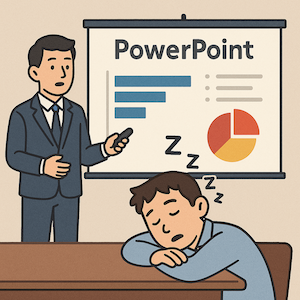
If there’s a more surefire way to kill a sale than a rambling, bloated PowerPoint presentation, we haven’t seen it.
Somewhere along the way, sales teams have forgotten that prospects are humans—not robots who crave 52 slides of features, charts, and company history. They’re people with problems, hoping that someone will come along and say, “Hey, I understand what you’re dealing with—and I’ve got a way to fix it.”
Instead, we get corporate monologues disguised as “sales decks.”
Let’s set the scene: a room (or worse, a Zoom) filled with people who were interested—until slide 4. The presenter has already blitzed through the origin story of their company, introduced everyone on the team (with bios), and displayed the full timeline of feature releases since 2013. Meanwhile, the prospect wonders if they have time to check their email—or fake a power outage.
What Went Wrong?
The presenter fell in love with their solution before acknowledging the prospect’s problem.
And that is the fatal flaw in sales messaging.
We talk about what we do. We explain how we do it. We fill the slides with diagrams, bullet points, and buzzwords. And we forget to do the one thing that makes people listen: show them that we understand them.
By the way, about those bullet points…
You may think “bullet points” are just a formatting tool. But legend has it the name came from people metaphorically pointing guns at presenters whose droning voices and endless bullet lists drained the life out of every room. Whether or not that’s true, we can all agree: most bullets miss the target.
The Human Brain Doesn’t Want a Lecture
It wants a story. It wants a guide. It wants hope.
You’re not just there to share information; you’re there to help someone make a decision—one that’s in their best interest. The PowerPoint isn’t your main character; your prospect is. Your job is to position your solution as the guide that helps them win the day.
Enter: Pecha Kucha
For anyone unfamiliar, Pecha Kucha is a Japanese storytelling format in which a speaker shows 20 slides, each for precisely 20 seconds. This totals 6 minutes and 40 seconds. They use very few words, mostly graphic images. Here is the key: the slides auto-advance, leaving no room to waffle or wander. It is an excellent tool for developing messaging discipline.
Try delivering your next pitch Pecha Kucha-style. It will compel you to distill your message, concentrate on what matters, and eliminate the fluff. You’ll need to be clear, quick, and personable. Ironically, this is the opposite of what most sales presentations do.
How to Cure Your Deck of Death
1. Lead with the Problem – Show your prospect you understand what they’re going through. Be specific. Make them feel seen.
2. Position yourself as the guide – don’t position yourself as the hero. Make the customer the hero and cast your product as the sidekick.
3. Cut the slides by half—then cut them again. If you’re explaining instead of engaging, your deck is doing damage.
4. Use Visuals, Not Text Blocks – If you’re reading your slides, why are you even there? Say less on screen so that people can focus more on you.
5. Practice the Pecha Kucha format— even if you don’t use it live, it’s a great way to refine your message.
6. Learn how to make your presentation WITHOUT ANY SLIDES! You probably don’t know your story well enough if you can’t do that.
Remember: People Buy Clarity
They buy what they understand. And no one understands a 45-minute feature demo that feels like a bedtime story told by a toaster. Simplify and clarify. Then speak directly to the person in front of you—their needs, challenges, and success story waiting to happen.
You don’t need more slides; you need more empathy.
More slides = confusion. And if you confuse, you lose!
Download a Pecha Kucha tip sheet HERE
If this series sounds like something you or your team needs, click the subscribe button so you won’t miss the next one.
We can help! Drop me a message—ask a question or two. We can help you find and sharpen your voice. info@thesaltzmangroup.com
To schedule a 30-minute discovery call, click HERE
Check out our 2-3 minute YouTube Snarky Summary HERE.