

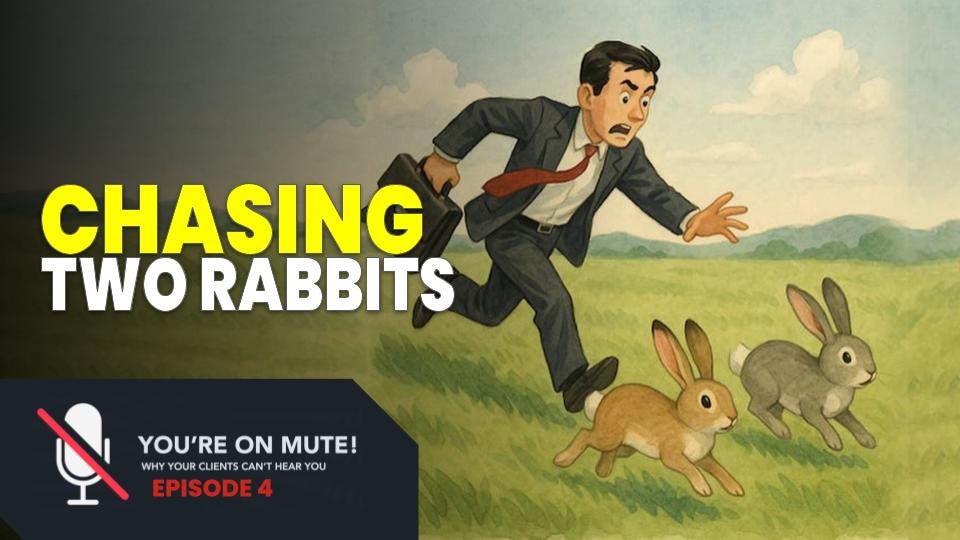
When you live in the South, as I do, you learn many fun (and often instructive) sayings. The first time I heard someone say, “You can’t chase two rabbits,” I must have had an expression that screamed, “Someone translate for the ignorant Yankee!”
My friend explained that it is a nice way to say you must focus on a single objective. If you try to catch two rabbits simultaneously, you will miss bagging either one of them.
It’s the same in messaging and marketing. If you try to market to two different buyers at once with a single message, you will miss both. It is like chasing two rabbits while blindfolded and yelling in two languages.
When we start working with a new client, we audit their existing marketing and learn about their business. Then, we take the first step, which is defining the problem our client solves for their prospects. This is unquestionably the most critical component of creating a clear, compelling message—and it is inevitably when the starting gun fires, signaling the start of the multi-rabbit race chase.
And it gets ugly . . . fast!
Our new client quickly realizes that their marketing suffers from what we call “Elmer Fudd Syndrome:
They are chasing wabbits.
Determining the problem they solve has become more challenging. Their current marketing often does an ineffective job of attracting either audience. Somehow, likely as a gradual devolution, they have convinced themselves that they can use some muddled middle message that doesn’t speak clearly to either of their newly discovered constituencies.
This is often a mind-blowing experience for clients with two (or more) different prospects, each of which has a real or perceived (more on this in our next episode) completely different problem they are trying to solve.
Example:
The client is a software company that sells a new CRM with a fantastic feature that automatically sends follow-up emails.
• The sales team thinks: “Awesome! Less busywork, more time to close deals.”
• The compliance team thinks: “Wait—are these emails approved? What about data privacy rules?”
Same solution, two very different perspectives—each group has distinct goals and concerns.
Here’s where it truly begins to unravel. In an effort to appeal to both teams, the company attempts to split the difference. The result? A bland, jargon-heavy homepage that says something like:
“Empowering scalable engagement through automated compliance-aware communication workflows.”
Translation: “We’re not sure who we’re talking to, but we hope one of you finds this interesting.”
No one does.
You know who wins? The competitor who puts a bold headline front and center:
“Sales teams love us because we help them close faster—without ticking off the compliance department.”
Boom. Clear. Specific. Rabbit caught.
Let’s break this down:
When you attempt to use one message to speak to two different audiences, you dilute it so much that it loses all flavor. It’s like making chili that’s part spicy, part mild, part vegan, part meaty. No one’s happy.
We’ve seen this countless times. The CEO wants to address both investors and customers simultaneously. Alternatively, a healthcare company aims to attract both plan sponsors and individual patients with a single campaign. Or—my favorite—the “we serve everyone” approach. That’s code for “we serve no one particularly well.”
Here’s what happens instead when you pick a single rabbit:
1. Your messaging gets sharper.
2. Your marketing becomes more effective.
3. Your sales team gets aligned.
4. You gain trust faster.
And before you ask: Yes, you can serve multiple types of clients. Just not with the same message at the same time. Think of it like having two landing pages, two nurture sequences, or two web sections tailored to each rabbit. You’re not saying different things—you’re saying the right thing to the right person.
That’s not fragmentation. That’s focus.
One of our clients, a fast-growing benefits platform, fell into the dual-rabbit trap. Their homepage attempted to communicate with HR leaders and benefit brokers using a single pitch. HR folks saw the word “broker” and bounced. Brokers thought the tool was for internal teams and tuned out. Once we separated the two paths—each with its own message, problem, and proof—the conversion rate doubled. Not “went up a little”—doubled.
Why? Because people felt spoken to. Understood. Valued.
The human brain is often lazy. It doesn’t want to decode your messaging. If I have to determine whether your solution is for me, I’m already gone. Your prospects aren’t lacking intelligence—they’re lacking time and attention.
So, here’s the takeaway:
If your product or service has multiple buyer personas, provide each of them with their own runway. Don’t force them onto the same landing strip and hope they don’t collide.
Tailor your language.
Customize your visuals.
Adjust your testimonials and proof points.
You don’t need a whole new brand—just message maps and guided content paths that show you understand each rabbit’s worldview.
Otherwise, you’re just Elmer Fudd, chasing wabbits and wondering why you’re still hungry.
Let’s wrap with this simple checklist to avoid dual-rabbit syndrome:
✅ Can you name your top two buyer types—without combining them?
✅ Does each have a different primary concern?
✅ Have you crafted a unique message, value proposition, and CTA for each?
✅ Does your website give each audience a clear path to follow?
✅ Are your sales assets (decks, emails, scripts) tailored by persona?
If you answered “no” to more than one of those, it’s time to pick a rabbit—and catch it.
Because when your message tries to do everything, it ends up doing… nothing.
And that’s not just bad marketing.
It’s bad business.
Download The Wabbit tip sheet HERE
If this series sounds like something you or your team needs, click the subscribe button so you won’t miss the next one.
We can help! Drop me a message—ask a question or two. We can help you find and sharpen your voice. info@thesaltzmangroup.com
To schedule a 30-minute discovery call, click HERE
Check out our 2-3 minute YouTube Snarky Summary HERE (please Like and Subscribe)
Thanks for reading You’re On Mute! ! This post is public so feel free to share it.