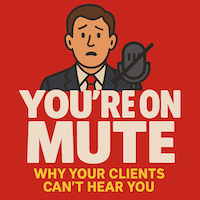
There’s a simple, universal rule in marketing and sales:
“If you confuse, you lose!”
It doesn’t matter how beautiful your website is, how catchy your slogan sounds, or how many awards your product has won. If your messaging makes a customer pause—even for a moment—to ask “Wait, what do they do?” then you’ve already lost the sale.
In today’s saturated marketplace, where attention spans are measured in seconds and decisions are made in moments, clarity is the most powerful competitive advantage your brand can have.
Clear Beats Clever—Every Time
Somewhere along the line, marketers got the idea that being clever was the goal. But here’s the truth:
Clever doesn’t convert. Clarity does.
A witty turn of phrase or a metaphor might make your team chuckle in a brainstorm, but if your ideal customer has to work to understand what you’re offering, they’ll bounce.
People don’t buy what they don’t understand.
If someone lands on your homepage and it takes them more than five seconds to figure out what you do, your bounce rate will skyrocket. That’s not because they’re dumb. It’s because the human brain is wired to avoid unnecessary effort.
Why Humans Avoid Mental Effort in Buying Decisions
Our brains are designed to conserve calories. In evolutionary terms, thinking hard used to mean burning precious energy that might be needed to outrun a saber-toothed tiger.
So we developed a shortcut system: we gravitate toward simplicity and avoid mental strain.
In marketing, this means that if your message forces your prospect to think too hard—decoding acronyms, translating industry-speak, or solving riddles—they’ll simply move on to the next brand that’s easier to understand.
They’re not lazy. They’re efficient. And clarity makes the buying decision easier.
Kill the Jargon. Speak Human.
One of the biggest clarity killers? Industry jargon.
These are the terms that might impress your peers but leave your prospects scratching their heads.
Let’s say your homepage proudly declares:
-
“We leverage data-driven synergies to optimize cross-channel activation and deliver scalable omnichannel ROI.”
That sounds impressive—until you realize your ideal customer just wants to know if you can help them get more leads.
Now compare that to:
-
“We help businesses get more qualified leads from their marketing—without wasting money.”
Clear. Simple. Customer-focused.
Jargon is a crutch. It gives the illusion of authority while putting distance between you and your customer.
Your goal is not to sound smart. Your goal is to be understood.
Confused vs. Clarified Messaging
Here are two quick real-world comparisons:
Software Company
❌ Confused:
“Our platform delivers integrated digital transformation solutions via a hyper-scalable SaaS ecosystem.”
✅ Clarified:
“A simple software tool that helps small teams manage projects, track progress, and hit deadlines.”
Financial Advisor
❌ Confused:
“We offer holistic wealth planning solutions driven by fiduciary frameworks and diversified portfolio structures.”
✅ Clarified:
“We help families build and protect their wealth so they can retire with peace of mind.”
In both cases, the clarified versions win. Not because they’re simpler, but because they’re clearer. They answer the one question every customer is silently asking:
“Can You Solve My Problem?”
That’s it. That’s the whole game.
Your customer isn’t looking for a vendor or a visionary. They’re looking for someone who understands their problem and can help fix it.
They don’t care about your backstory, your technology stack, or your vision statement—not until they know you can help them.
Every piece of your messaging—website, sales deck, tagline, bio—should pass this test:
– Can someone quickly identify what problem you solve?
– Can they see how your solution makes life better?
If not, it’s time to simplify.
The 5-Point Clarity Checklist
Here’s a simple framework to audit your message and create instant clarity:
1. What do you offer?
Say it plainly. No fluff.
Example: “We design websites for law firms.”
2. Who is it for?
Your ideal customer should feel like you’re talking directly to them.
Example: “Busy parents who want healthy meals fast.”
3. What problem do you solve?
Lead with the pain they already feel.
Example: “Tired of missing leads because your CRM is a mess?”
4. How does it make life better?
Paint the picture of success.
Example: “Save hours each week and finally feel on top of your workflow.”
5. What should they do next?
Be direct. Don’t make them guess.
Example: “Book a free 15-minute call.”
Final Thought: Simplify to Amplify
If you want your marketing to work harder, make your message simpler. Not simplistic—just clear.
Clarity doesn’t mean dumbing things down. It means removing every barrier between your customer and their decision to buy.
Remember: your customer isn’t looking to admire your cleverness. They’re looking for a trusted guide who can solve a real problem.
So next time you’re tempted to get fancy with your messaging, ask yourself:
Would a fifth grader understand this?
If the answer is yes, then congratulations—you’re on your way to winning more business.
Download the episode checklist – CLICK HERE
Check us out on YouTube (Click on Episode 2) for a 2–3 minute Snarky Synopsis – CLICK
We can help!
What’s your marketing/messaging challenge? Drop me a message—ask a question or two. I’d love to help you find and sharpen your voice.
Want to talk it through? Schedule a 30-minute discovery call: CLICK
For weekly messaging and marketing wisdom, subscribe and get a new “You’re On Mute” every week.