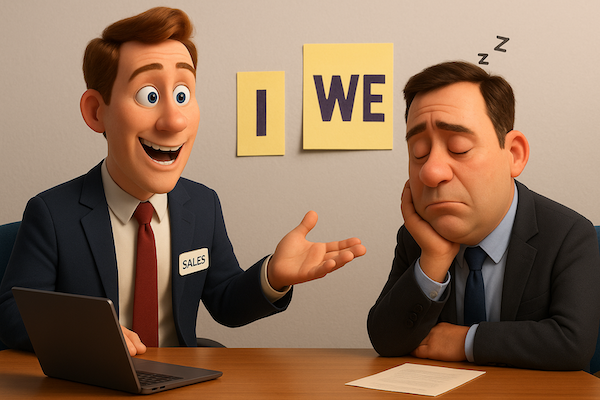
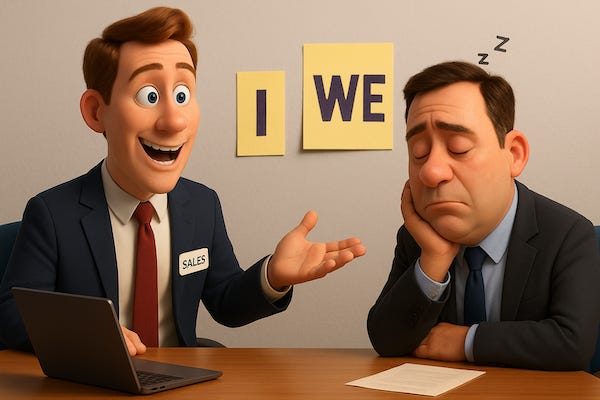
One of the first lessons we learn about grammar is how to use pronouns correctly. It starts with the first-person singular “I” and the plural “we.” As the lessons progress, students are introduced to the concepts of subjective and objective pronouns, followed by singular, plural, and possessive pronouns. By the time they reach 3rd grade, they are little pronoun experts. However, there is something about pronouns, especially the first two, that is not taught in school.
“I” and “we” are kryptonite for sales success.
In previous episodes, we have covered the initial steps in creating a compelling story: identifying your ideal client, understanding and articulating their problem, and exploring how they perceive the issue from different psychological angles. But those are just the basics of the rest of the process.
The role of the guide is arguably the most overlooked yet vital part of business storytelling. Most companies naturally assume they should be the hero, listing features, awards, credentials, years in business, or the common “we care” statements. But here’s the hard truth: if you position yourself as the hero, your client has no role in your story. And that’s a problem — because your client is already the hero of their own story. They’re not looking for another hero. They’re looking for a guide.
At this stage in the process, introduce yourself (or your business) as the guide in the story. Think Yoda or Gandalf. You don’t overshadow the “hero” (your client or prospect). It’s crucial to keep the focus on THEIR problem, not on you or your business. You see this logic and structure every day, though you probably haven’t noticed it. That’s because their main focus is always one thing: solving the client’s problem.
Dr. Rick, Jake, and Lilly
Bill Glass, Kevin Myles, and Milana Vayntraub are better known as Dr. Rick (Progressive Insurance), Jake (State Farm), and the Lilly (AT&T). Why are they even in the commercials in the first place? Because their characters embody the two traits a guide must possess and display: empathy and authority.
Dr. Rick says, “You’re not alone. This happens to a lot of people.” That’s empathy speaking! He literally wrote the book, “Un-becoming Your Parents,” and presents himself as a therapist or life coach. That’s his authority. Jake says, “I get where you’re coming from,” and he doesn’t just sympathize; he knows what he’s doing and always comes across as a pro. Lilly is approachable and inclusive: “We want to make sure everyone gets our best deals.” Authority? She’s in charge of the store!
There is no “I” in their dialogue. They don’t talk about every feature or their tech stack. They understand that the main thing is to keep the main thing the main thing.
Great guides appear at just the right moments in every powerful story. Luke meets Yoda only when he’s overwhelmed. Frodo encounters Gandalf as his normal life begins to fall apart. Katniss is trained and encouraged by Haymitch only after she’s thrown into the Hunger Games. In each case, the guide doesn’t steal the spotlight — they shine it. And more importantly, they illuminate the path forward.
Guides show empathy and authority
The most successful brands do the same. They understand that the customer is on a journey, and they customize their messaging to meet the customer at their moment of need. They achieve this by embodying two key traits, just like Dr. Rick, Jake, and Lilly: empathy and authority.
Empathy is how you connect. It’s how you say, “I see you. I understand what you’re going through. You’re not alone.” And it’s not just fluff. Neuroscience shows that people tend to make decisions based on emotion first, then justify them with logic. If your brand appears cold, clinical, or purely transactional, you lose the sale before it even starts.
Authority is how you reassure others. It’s how you say, “I’ve done this before. You’re in good hands.” But authority without empathy makes you sound like a know-it-all. Empathy without authority makes you sound like a well-meaning amateur. You need both, just like every trusted guide in every great story.
Let’s revisit the sales-dampening pronouns: “I” and “we.” When a company starts with these, it’s often trying to highlight its value. “We’ve been in business for 40 years.” “I’m passionate about helping clients.” “We use cutting-edge technology.” Those statements might be true, even admirable. But they’re not persuasive.
Your client doesn’t wake up thinking about how long you’ve been in business. They wake up with a problem to solve. Therefore, every part of your messaging should focus on one idea: We understand your situation, and we know how to help you fix it.
Make the shift and lift your sales and marketing
This shift in storytelling—from hero to guide—is more than just a narrative choice. It’s a business strategy that quickly builds trust, maintains clarity in your message, and makes your offer irresistible.
Think of it this way: When you lead with “we,” you make your prospect work to understand your message. When you focus on them — their fears, frustrations, and goals — you earn the right to be heard.
That’s why the most effective marketing never feels like marketing. It sounds like someone who understands you. It sounds like someone who has been through it, solved it, and can help you do the same.
Build connections and long-term relationships
In today’s noisy, oversaturated sales environment, clarity and empathy are essential. Being the loudest no longer works; being the most helpful does.
If your current messaging still emphasizes what you do and why you’re great, try this simple exercise: Take your top five marketing statements and rewrite them with the client as the hero. Remove “I” and “we” entirely. Start with their problem. Conclude with their success. And subtly position your role as the guide — confident but quiet — in the middle.
Because if you get the role of the guide right, you don’t just make a sale. You build a connection. You foster trust. You establish a relationship. In the end, that’s what every great story — and every successful brand — is truly about. And if you don’t, you’re on mute!
TURN TANGLED TALK INTO TIGHT TAKEAWAYS!
Discover how we can help you cut through the noise, reach the right customers, and keep your pipelines full.
SCHEDULE a 30-minute discovery call, and ask about our special offer for Substack subscribers.
One More Thing
For you TL;DR folks (you know who you are), check out our YouTube Snarky Summaries. (please LIKE and SUBSCRIBE)