
This is the first of a three-part series about the stories smart professionals tell themselves to avoid fixing their communication.
They Just Don’t Get It
When communication fails, most professionals reach for the same explanation: “They just don’t get it.” It’s a tidy conclusion. It preserves your confidence, keeps the problem on the other side of the table, and requires nothing of you. You understood your message. You explained it clearly. You may have explained it more than once. If they still didn’t respond, well—that’s on them.
That conclusion is almost always wrong. And more importantly, it’s unproductive.
What “Don’t Get It” Usually Means
In most cases, when someone says the audience doesn’t get it, what they’re actually describing is a lack of action. The prospect didn’t follow up. The client didn’t decide. The stakeholder didn’t prioritize the recommendation. The absence of movement gets interpreted as evidence of confusion.
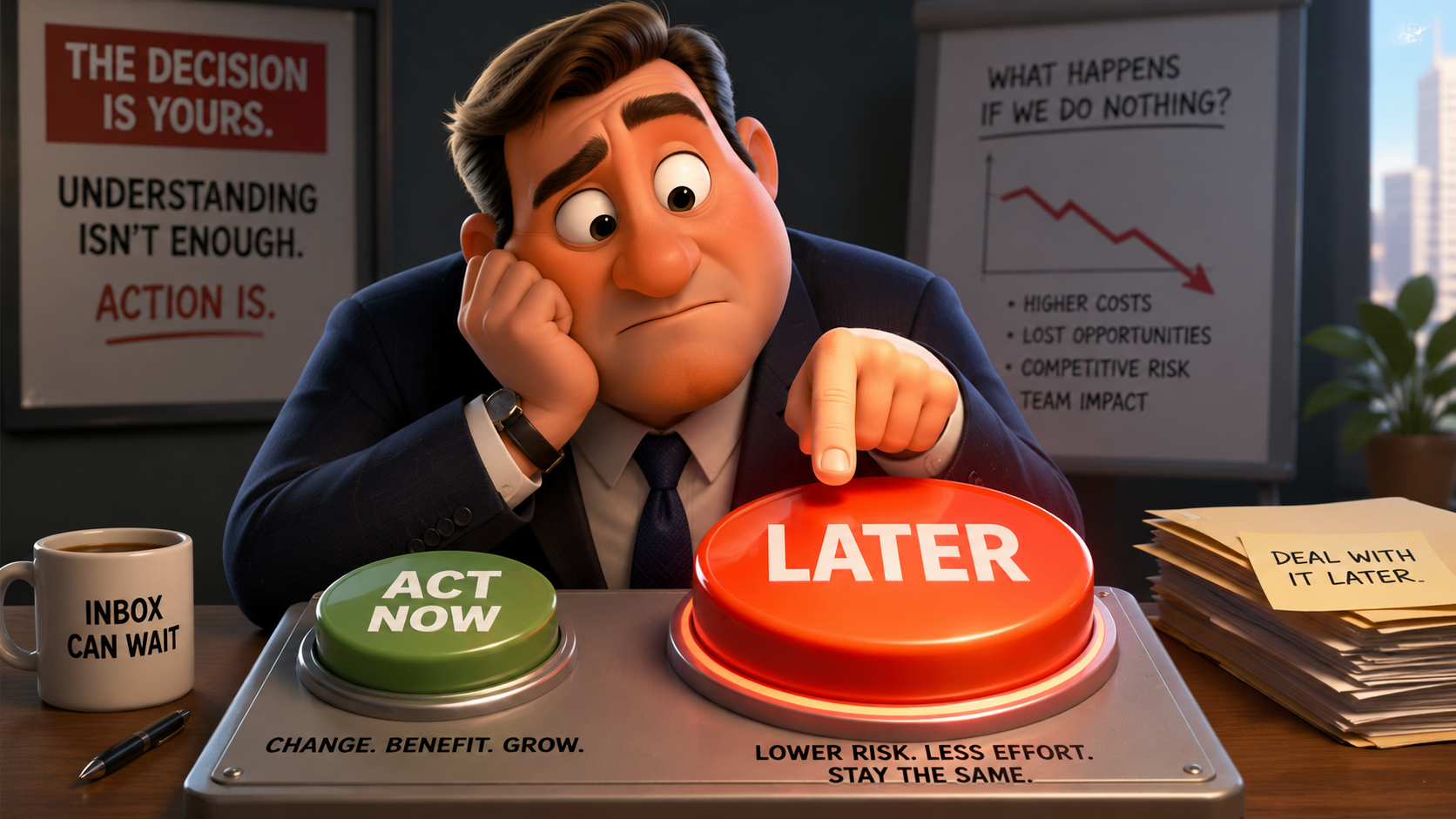
This is a critical misread. People can understand you perfectly and still choose not to act. Understanding is a cognitive state. Action is a behavioral decision shaped by perceived value, risk, effort, and timing. When those factors don’t align, people default to inaction—even when your message was crystal clear.
Clarity Is Not the Same as Persuasion
A message can be clear without being compelling. You can structure your thinking logically, back it with data, and answer every reasonable question—and still fail to create urgency or momentum. Clarity tells your audience what you’re saying. Persuasion gives them a reason to care.
Persuasion connects information to what matters immediately to the listener. It creates a reason to act now, not later. When it’s missing, all the clarity in the world won’t move the needle. Your audience may follow your logic perfectly and still feel no pressure to change anything.
A Scenario Worth Recognizing
A consultant presents a well-supported analysis showing a company how to reduce healthcare costs by restructuring its benefits plan. The data is solid. The reasoning is sound. At the end of the meeting, the client thanks them, acknowledges the insight, and says they’ll review it internally.
Weeks pass. No decision. The consultant concludes the client must not have fully grasped the opportunity and schedules a follow-up with even more detail.
What the consultant missed: the client understood the proposal completely. They simply decided the effort, disruption, and risk of change outweighed the benefit. The problem wasn’t comprehension. It was prioritization. And more detail wasn’t going to fix that.
Why We Default to Blaming the Audience
Blaming the audience is psychologically convenient. It lets you maintain confidence in your expertise without confronting the possibility that your communication isn’t achieving the desired result. If the problem is theirs, there’s nothing you need to examine.
Owning the outcome is harder. It forces you to ask whether you’re addressing the factors that actually drive decisions—or just presenting information in a way that feels complete to you. That’s an uncomfortable question. Which is exactly why most people skip it.
The Missing Piece: Consequences
One of the most consistent gaps in professional communication is failing to make the cost of inaction tangible. Most people are comfortable explaining what’s happening and what could be done. Far fewer clearly articulate what will happen if nothing changes.
Without consequences, there’s no urgency. Doing nothing is always the lowest-risk, lowest-effort option—and in the absence of a compelling reason to act, it’s the option most people will choose. When you make the cost of inaction specific, concrete, and connected to something your audience already cares about, the conversation shifts. The decision becomes practical, not theoretical.
The Right Question to Ask Yourself
Stop asking: “Did they understand my message?”
Start asking: “Does my message make action feel necessary?”
That shift moves you from completeness to urgency—from covering the topic thoroughly to creating the conditions that make a decision easier to make. The goal isn’t to transfer all of your knowledge. It’s to move something forward.
In your next high-stakes conversation, pay attention to how you frame the consequence of inaction. Don’t stop at describing the problem. Extend it: what will happen if nothing changes? Make it specific enough to matter to this person, in this context, right now.
The Bottom Line
Your audience isn’t a passive recipient of information. They’re active decision-makers, constantly weighing whether something deserves their time, attention, and risk. When your message doesn’t give them a compelling reason to act, they’ll default to staying where they are. That’s not a failure of understanding. It’s a rational response to a message that didn’t make action feel worth it.
When you say “they just don’t get it,” you often overlook the more accurate reality: they got enough to decide not to act. If you want different results, stop adding more explanation and start addressing the factors that actually shape decisions—relevance, consequence, and urgency.
Your audience is not confused. They’re not waiting for one more slide or one more data point. They’re waiting for a reason. And if you keep assuming the problem is that they don’t get it—if you keep refining your explanation instead of rethinking your approach— …you’re on mute.