When I first studied StoryBrand with Don Miller and his team, I thought I had a solid grasp of how to effectively communicate my business. That illusion lasted about ten minutes.
One of the exercises asked us to run the entire StoryBrand framework on our own businesses. Forty of us sat there, scribbling our versions of the story we wanted our clients to hear. Then Don’s team wandered the room, listening, critiquing, and offering suggestions. Their most frequent critique? ‘…too many words.’
I can still hear Don’s voice ringing in my ears: “If you confuse, you lose.” And one of the fastest ways to confuse the very clients you’re trying to attract is by burying them under a landslide of words. It’s a mistake I had made myself. Like many of the folks in that room, I believed the more words I used, the smarter and more persuasive I sounded. What I learned that day was that the opposite is true.
The Seduction of More Words
So why do so many businesses fall into the trap of using too many words in their messaging?
They’re too close to their own product. When you live inside your offering every day, you know every detail, feature, and possible outcome. The temptation is to reveal everything. To you, it feels like providing value. To your prospect, it feels like punishment.
They confuse thoroughness with clarity. Many believe that if they say everything, nothing important will be left out. But research shows that the human brain does not process “everything.” It processes what is clear, relevant, and emotionally resonant.
They fear being misunderstood. Ironically, the more they talk, the greater the chance of being misunderstood. Piling on words to protect against misinterpretation often creates exactly the confusion they hoped to avoid.
Why Less Really Is More
There’s a neurological reason Don’s mantra works. Cognitive scientists have long demonstrated that our brains are wired for efficiency. The average adult attention span has dropped to around 8.25 seconds, shorter than a goldfish, according to Microsoft’s consumer insights lab.
The Journal of Neuroscience published findings that when faced with too much information, the brain shifts into a state of “cognitive overload.” Instead of engaging, it disengages, conserving energy for simpler, easier tasks. Translation: your prospects won’t work hard to figure out what you mean. If you don’t make it instantly clear, their brain taps out.
Business legend Jim Collins put it bluntly: “If you have more than three priorities, you don’t have any.” The same principle applies to communication. If you cram six paragraphs of features into a brochure, you’re not making six points. You’re making none.
Seth Godin echoes this in his signature style: “People do not buy goods and services. They buy relations, stories, and magic.” Stories and magic don’t thrive in clutter. They need space to breathe.
The Hidden Costs of Over-Worded Marketing
Too many words don’t just create confusion; they actively damage your credibility and your sales pipeline. Here’s how:
They make you sound insecure. Prospects can smell desperation. Over-explaining makes it appear that you don’t believe your product can stand on its own.
They delay decision-making. Behavioral economists have shown that too many choices paralyze buyers. The same holds true for too many words. When prospects face a wall of copy, they push the decision down the road. And later, it rarely comes.
They rob your message of emotional punch. Emotion drives buying decisions. However, emotion gets lost in the weeds when every possible detail vies for attention.
Examples: Bloated vs. Clear
Over-worded pitch: “Our software platform is an industry-leading, best-in-class, scalable solution that leverages cutting-edge artificial intelligence technology to provide a robust, comprehensive suite of customizable features that can be uniquely tailored to fit the diverse and evolving needs of businesses across multiple verticals and industries.”
Clear pitch: “Our software helps businesses cut costs and save time by automating repetitive tasks.”
Which one would you remember?
Over-worded pitch: “Our new toothbrush has patented, triple-density bristles that are scientifically designed to optimize plaque removal while enhancing gum health, paired with an ergonomic, slip-resistant handle to ensure superior comfort and usability for a wide range of customers.”
Clear pitch: “This toothbrush cleans better and feels great in your hand.”
The difference is night and day. One is designed to impress colleagues. The other is designed to connect with customers.
The Communication Touch Point
This issue isn’t confined to your marketing collateral. It’s about every communication touch point your business has with the outside world. Every email, every presentation, every video is either clarifying your value or burying it under noise.
Mark Twain once quipped: “I didn’t have time to write a short letter, so I wrote a long one instead.” The same holds true for marketing. It’s easy to pile on words. It takes real discipline to cut them down to what matters. But when you do, your clients finally hear you.
In that first StoryBrand workshop, I learned that fewer words don’t mean less meaning. They mean more power. More resonance. More trust. And in business, trust is everything.
Final Word
The myth of more words is one of the most expensive myths in marketing. More words don’t make you sound smarter. They don’t make your product look better. They don’t close more sales.
Clarity wins. Brevity wins. Simplicity wins. The companies that succeed are those that ruthlessly strip away excess words until only the meaning remains.
Because at the end of the day, if your clients can’t understand you quickly and easily, they won’t act. And if they can’t hear your message above the noise, you’re on mute.
Struggling to stand out, reach the right customers, and fill your pipeline? We can help.
Schedule a 30-minute discovery call to learn about our exclusive offer for Substack subscribers.
One More Thing
For you TL;DR folks (you know who you are), check out our YouTube Snarky Summaries. (please LIKE and SUBSCRIBE)
A trusted guide shows you the hazards up front. How do you become a trusted sales guide? Answer objections BEFORE your prospect or client asks them. It may seem counterintuitive, but there a mountain of evidence that shows this to be an effective technique for creating trust and closing sales.
“The more you talk about the thing everyone else is scared to mention, the more you become the trusted voice.” — Marcus Sheridan, They Ask, You Answer
If you have spent any time in sales or marketing, you have probably been told to “stay positive” and “avoid raising objections” that prospects might not even be thinking about. But here is the truth: they are thinking about them. And if you do not bring those objections up first, your competitors, or worse, your prospect’s imagination, will fill the silence.
Sheridan built his entire philosophy on this simple premise: answer the real questions buyers have, openly and early, even if those questions feel uncomfortable. Especially if they feel uncomfortable. When you take the lead on the tough stuff, such as price, weaknesses, limitations, and comparisons, you disarm skepticism, build credibility, and often close sales faster.
Why Hiding Objections Backfires
Silence around objections creates distrust. Neuroscience research shows that when people sense information is being withheld, the brain’s amygdala, the fight-or-flight center, kicks into gear. A 2017 study in Frontiers in Human Neuroscience found that uncertainty activates the same neural pathways as physical threats, making people less likely to act and more likely to retreat. In other words, dodging questions feels to the buyer like danger.
Management guru Peter Drucker once wrote, “The most important thing in communication is hearing what isn’t said.” If your prospect is silently asking, “Why does this cost more than the competitor?” and you are ignoring it, they are hearing something loud and clear: you are not being straight with me.
Transparency as a Trust Multiplier
Harvard psychologist Amy Cuddy, in her book Presence, argues that trust is established through two key signals: warmth and competence. Addressing objections early checks both boxes. You show warmth by acknowledging that the prospect’s concern is valid (“That is a fair question”), and you demonstrate competence by confidently answering it with facts and perspective.
It is not just soft skills; it is measurable. A 2020 Edelman Trust Barometer report found that 81% of consumers said trust in a brand was a “deal-breaker” or “deciding factor” in a purchase decision. By proactively tackling objections, you signal: “We have heard this before, we understand your concern, and here is how we address it.” That is trust in action.
Stephen Covey, author of The Speed of Trust, put it this way: “When trust goes up, speed goes up, and cost goes down.” Bringing up objections does not slow the sales cycle, it accelerates it by eliminating the hidden speed bumps that cause hesitation.
The Brain Science of Answering Objections
Behavioral economics gives us another clue as to why Sheridan’s advice works. Daniel Kahneman, Nobel Prize–winning author of Thinking, Fast and Slow, explains that humans rely on two systems of thought: fast (emotional, instinctive) and slow (deliberate, logical). Objections live in the fast brain. They pop up as emotional red flags: Too expensive. Too risky. Too complicated.
When you address objections directly, you move them out of the emotional system and into the rational one. You are essentially telling the brain: Do not panic, let’s analyze this. Research in NeuroImage has shown that when people are presented with clear explanations of risks, activity decreases in the amygdala and increases in the prefrontal cortex, the part of the brain that handles reasoning. Translation: when you explain the tough stuff, you literally calm the fear center of the brain and engage the logic center.
What Bringing Up Objections Looks Like
Let us be clear: this is not about giving prospects a list of reasons not to buy. It is about framing the conversation honestly and on your terms. Sheridan himself is famous for advising companies to create content that addresses what he calls “The Big 5”:
1. Price/Cost – What does it cost, and why? 2. Problems/Negatives – What could go wrong, or what is not ideal? 3. Versus/Comparisons – How do you stack up to the alternatives? 4. Reviews – What do real customers say? 5. Best in Class – Who are the top players in the space, even if it is not you?
Handled with transparency, these are not sales-killers, they are sales accelerators. Imagine the difference between a prospect Googling “Problems with Product X” on their own (and landing on a competitor’s page) versus finding a video where you openly explain what your product does well, what it does not, and who it is best for. One path builds suspicion. The other builds authority.
Why It Creates Sales, Not Just Trust
Building trust is nice, but let us not forget the point: sales. Here is why bringing up objections actually closes deals:
It differentiates you. Most competitors will avoid hard questions. By leaning into them, you instantly stand out as more honest and confident.
It shortens the sales cycle. Prospects do not need to “go think about it” if you have already answered the sticking points they would be pondering.
It reduces price sensitivity. Research in The Journal of Marketing shows that transparency increases perceived fairness. When you explain your pricing, especially if it is higher, buyers are more likely to accept it.
It creates psychological relief. By naming the elephant in the room, you remove the low-level anxiety buyers carry into a decision. Less anxiety equals more buying.
Chris Anderson, former curator of TED, once said: “Your number one task as a communicator is to convince people that you know what you are talking about and that you can be trusted.” Nothing does that faster than saying out loud what your prospect is already whispering to themselves.
Final Word
Marcus Sheridan’s mantra is not just a clever line; it is a roadmap for trust, clarity, and conversions: “The more you talk about the thing everyone else is scared to mention, the more you become the trusted voice.”
Hiding objections does not protect you; it sabotages you. Prospects already know the questions. The only real question is: do they trust you to answer them, or will they turn to someone else?
So next time you are writing a blog, recording a video, or sitting in a sales call, do not dodge the tough stuff. Bring it up. Own it. Explain it. Because when you lead with transparency, you do not just win the argument, you win the business. When you don’t, you’re on mute.
Struggling to stand out, reach the right customers, and fill your pipeline? We can help.
Schedule a 30-minute discovery call to learn about our exclusive offer for Substack subscribers.
One More Thing
For you TL;DR folks (you know who you are), check out our YouTube Snarky Summaries. (please LIKE and SUBSCRIBE)
If you don’t tell buyers what “button to push,” they won’t — and your campaign just becomes expensive wallpaper.
Marketing is about movement. You want your prospect to move from “just looking” to “ready to buy,” or at least to take the next step toward that decision. Yet, one of the most common—and costly—mistakes marketers make is forgetting the simplest part of the process: telling people what to do next. In other words, including a clear Call to Action (CTA).
You’d be surprised how often businesses spend thousands crafting slick campaigns, polished websites, and glossy brochures that never actually tell the reader what to do. No “Schedule a demo.” No “Buy now.” No “Download the guide.” Just a message hanging in the air, waiting for the buyer to figure out the next step on their own. Spoiler alert: they rarely do.
Let’s explore why CTAs are critical, why marketers often neglect them, how buyers behave in their absence, and examine a couple of painful real-world examples of marketing that went mute because the CTA was missing.
Why Buyers Need a Clear CTA
Human beings don’t thrive on ambiguity. Decision fatigue is real, and psychology tells us that people are more likely to act when they are given a simple, obvious, and low-friction next step. Research from the Journal of Consumer Research shows that even minor friction or uncertainty decreases the likelihood of action, especially when buyers are already juggling multiple demands for their attention.
A CTA functions as a mental shortcut. Instead of forcing the buyer to ask, “What should I do with this information?” the CTA provides an immediate, clear path: “Click here to start your free trial.” It lowers the cognitive burden and builds momentum. Without it, even the most compelling message fizzles out.
Neuromarketing studies back this up. MRI scans of consumer decision-making reveal that when a person is given a clear instruction tied to a perceived benefit, their brain lights up in the same way it does when anticipating a reward. The CTA isn’t just a sales tactic—it literally engages the brain’s reward system and creates a forward pull.
Why Marketers Often Neglect CTAs
If CTAs are so effective, why do marketers so often forget them? There are three common reasons:
1. Assumption Bias – Marketers assume the next step is obvious. They believe the value proposition is so clear that buyers will naturally know what to do. But the truth is, even highly motivated buyers need direction.
2. Fear of Being “Salesy” – Many brands want to be helpful and avoid coming across as pushy. They hide their ask in vague language (“Learn more”) or leave it out entirely. But a CTA isn’t about being pushy—it’s about being useful. Buyers want clarity, not coyness.
3. Design and Content Disconnect – Sometimes the problem is structural. A beautifully designed landing page gets so wrapped up in aesthetics that the CTA gets buried, blends into the background, or disappears altogether. Copywriters and designers may not coordinate, and the result is a message with no clear action point.
What Happens When There’s No CTA
So what do buyers do when there’s no CTA? Research from WordStream and HubSpot provides a sobering answer: they bounce. In fact, HubSpot’s testing shows that adding a single clear CTA button increased conversion rates by over 120%.
Without a CTA, buyers: – Abandon the page or ad because they don’t see a clear path forward. – Delay action with the intention of “coming back later”—a psychological graveyard where most intentions die. – Switch to a competitor who makes the next step easier.
In other words, failing to provide a CTA is like dropping your fishing line in the water but forgetting to attach a hook. The bait is there, but nothing catches.
Two Painful Examples of Missing CTAs
Example 1: The Webinar That Went Nowhere A mid-sized SaaS company spent heavily to promote a thought-leadership webinar. The event was polished, the presentation engaging, and attendance strong. But when the webinar wrapped, the host simply thanked everyone for attending and signed off. No invitation to schedule a demo. No link to download a white paper. No free trial offer. The marketing team later admitted they assumed the audience would naturally visit the website afterward. They didn’t. Post-event analytics showed a negligible spike in site traffic and zero attributable sales.
Example 2: The Gorgeous Brochure With No Next Step An employee benefits firm produced a beautifully designed, full-color brochure outlining their services. It highlighted expertise, included compelling client testimonials, and even had a clever tagline. What it didn’t have was a phone number, website, or QR code anywhere in the piece. Prospects were left to Google the firm’s name—and in doing so, some stumbled onto competitors. The firm spent thousands printing what amounted to little more than expensive desk décor.
Both of these failures stemmed from the same issue: no CTA. Each was an otherwise solid marketing effort rendered ineffective because the audience wasn’t told what to do.
How to Craft CTAs That Actually Work
It’s not enough just to have a CTA—you need one that is clear, compelling, and context-appropriate. Here are three guidelines:
1. Clarity Over Cleverness – Your CTA should be unmistakable. “Schedule your demo now” beats “See what we’re talking about.” Clever language can amuse, but clarity converts.
2. One Path Forward – Don’t overwhelm your prospect with a dozen choices. Research from Columbia University’s famous jam study shows that too many options paralyze decision-making. Give buyers one clear next step.
3. Visibility and Urgency– Your CTA should stand out visually and create a sense of timely relevance. Buttons, bold text, and positioning all matter. Adding urgency (“Register today”) can provide the nudge that makes the difference.
Why This Matters
Every piece of marketing is an investment. Every ad, email, landing page, and podcast episode costs money, time, and energy. Without a clear CTA, that investment often yields nothing. Buyers aren’t mind-readers. They need direction.
The irony is that failing to include a CTA doesn’t make your marketing feel more professional or less pushy—it just makes it invisible. As Donald Miller of StoryBrand puts it: “If you confuse, you lose.” Leaving out a CTA is the ultimate confusion.
Final Word
Marketing without a CTA is like handing someone a beautifully wrapped gift and then never letting them open it. It leaves your audience intrigued but unsatisfied, and it leaves your sales pipeline empty.
The next time you craft an ad, write an email, or launch a campaign, remember: people won’t act unless you ask them to. And if you forget to include a clear, simple, visible Call to Action—well, you’re on mute.
Struggling to stand out, reach the right customers, and fill your pipeline? We can help.
Schedule a 30-minute discovery call to learn about our exclusive offer for Substack subscribers.
One More Thing
For you TL;DR folks (you know who you are), check out our YouTube Snarky Summaries. (please LIKE and SUBSCRIBE)
Once you’ve established your customer as the main character in the StoryBrand framework and clarified their problem, the next step is vital: provide them with a plan. Not just any plan, but one so clear and simple that it stands out from the noise and makes them think, “Yes, I can do that.”
Too often, businesses do the opposite. They give prospects a 20-page process map or, worse, drown them in jargon-heavy PDFs and complicated explanations. Their intention might be good—showing thoroughness and expertise—but the result can be damaging. Eyes glaze over. The prospect tunes out. Momentum stalls.
The truth isn’t that customers are lazy; it’s that they’re human. Human brains are wired to conserve energy, avoid feeling overwhelmed, and quickly identify what’s essential for survival. If your plan feels like heavy lifting, their instinct will be to retreat rather than engage.
The Psychology of Simplicity
Cognitive science shows us that the human brain is good at conserving energy. Daniel Kahneman famously described two modes of thought: System 1, which is fast and intuitive, and System 2, which is slow and effortful. System 1 is where we want our customers’ decision-making to happen when they see our plan. If they can understand it quickly and immediately picture themselves succeeding, they’re much more likely to follow through.
The moment you force them into System 2—requiring analysis, complex comparison, or detailed study—you’ve lost the fight. Not because they don’t care, but because their brain is wired to default to what’s easiest to understand.
This is why complex plans don’t just fail; they actively create resistance. A confused mind doesn’t buy. A clear mind moves forward.
Neuroscience of the Glazed-Over Prospect
Think of the last time you received a technical manual for a new gadget. Before you reached page two, your brain began triaging: Do I really need this? Is there a faster way? Can I figure it out later? That flow of thoughts is your working memory signaling a shutdown.
Working memory, the brain’s temporary storage, is quite limited. It can only handle a few items at once. When you overload it with details, your prospect’s brain reacts the same way yours does with that manual: tuning out, setting it aside, and hoping the answer appears elsewhere.
This isn’t laziness. It’s survival instinct. The brain evolved to filter out what seems like excess. So, as a guide, your job is to give prospects a plan their brains can actually hold—one that fits into working memory and feels immediately doable.
The Power of Three
There’s a reason great speeches, memorable slogans, and timeless lessons are often structured in threes. Neuroscience confirms that the brain finds three items easy to understand and remember.
When you’re creating your plan, focus on three simple steps. Not seven. Not nine. Just three.
– Step 1: Present the first, easy action to take. – Step 2: Provide small, clear wins along the way. – Step 3: Highlight the finish line and celebrate progress.
This is not about reducing complexity. It’s about demonstrating how human cognition truly works. When your plan is that straightforward, your customer feels capable. Feeling capable fosters trust. Trust leads to conversions.
Why Over-Explaining Kills Trust
Paradoxically, the more complex and detailed your plan, the less confident you seem. Instead of showing confidence, it suggests uncertainty—like you’re hedging your bets or hoping the abundance of details will hide a weak proposal. Customers don’t need to know everything you know; they need to see the clear path forward, simplified to its core. By avoiding the urge to over-explain, you demonstrate expertise. The expert doesn’t drown you in data; the expert shows you the shortcut.
Real-World Application
Imagine you own a financial advisory firm. You could give new clients a 60-page onboarding packet, full of market models, historical graphs, and risk equations. Or you could provide a simple one-page plan:
1. Schedule a strategy session. 2. Pick the portfolio that fits your goals. 3. Relax—we’ll keep an eye on things and make adjustments as needed.
The second option not only reduces friction but also creates momentum. Clients don’t feel like they’re taking on extra work; they feel like they’re already making progress. That emotional shift makes them more likely to follow through.
Respecting Human Design
At the core of StoryBrand is empathy—understanding your customer’s journey and crafting communication that respects their reality. When you provide them with a plan, you’re not spoon-feeding. You’re aligning with how their brain naturally processes information.
It’s worth repeating: people are not lazy. They are biologically wired to use the least energy necessary to succeed. That’s not a flaw; it’s a feature. And if your marketing respects that, you’ll differentiate yourself from competitors who still expect prospects to wrestle with endless details before saying yes.
Your Next Step
When you give your customer a plan, you’re not just providing directions; you’re also offering a clear path forward. You’re giving them psychological reassurance. You’re saying: This isn’t complicated. You can do this. Here’s how.
And if you can make them believe that, you’ll earn their trust, their attention, and often, their business.
Because in a marketplace filled with noise, long-winded explanations, and overwhelming complexity, if your plan isn’t simple, clear, and actionable…
…you’re on mute!
Struggling to stand out, reach the right customers, and fill your pipeline? We can help.
Schedule a 30-minute discovery call to learn about our exclusive offer for Substack subscribers.
One More Thing
For you TL;DR folks (you know who you are), check out our YouTube Snarky Summaries. (please LIKE and SUBSCRIBE)
Sales has always had its archetypes. On one end is the “Don Juan School of Selling”—forever chasing the next conquest, armed with charm, quick promises, and little thought about tomorrow. On the other end is the trusted advisor, the one who invests in long-term relationships, communicates with clarity, and positions themselves as a knowledgeable guide.
Both approaches may close deals. But only one builds trust, repeat business, and a reputation that compounds over time.
The Lure of Don Juan Selling
The Don Juan seller thrives on novelty. Each prospect is a conquest, each deal a fleeting win. Like a serial dater, this salesperson is more interested in the thrill of the chase than the commitment of a relationship.
At first glance, it can seem effective. After all, a smooth talker can make quick wins. But there’s a cost. Prospects eventually sense when they’re being treated as a notch on someone’s sales belt. They don’t feel heard. They don’t feel valued. And they certainly don’t feel any loyalty when the next offer comes along.
Don Juan selling is transactional at its core. It’s about today’s commission, not tomorrow’s trust.
The Alternative: Selling as a Guide
StoryBrand has popularized the notion of positioning yourself not as the hero of the story, but as the guide who helps the hero—your client—overcome obstacles and achieve their goals. This simple shift changes everything.
When you communicate as the guide, you do three critical things:
Show Empathy. You acknowledge the client’s fears, frustrations, and challenges. This signals that you understand them at a human level.
Demonstrate Authority. You show that you have the knowledge and tools to help them succeed. Authority, balanced with empathy, creates credibility.
Offer a Clear Plan. You don’t overwhelm with jargon or a laundry list of features. Instead, you make the path forward simple and achievable.
This type of communication triggers something deeper in the brain. Neuroscience tells us that the human mind is wired to conserve energy. When faced with a barrage of complexity, people shut down—eyes glaze, attention fades. But when given a clear, simple plan from a trusted guide, the brain perceives it as safe and actionable. That’s why people follow leaders who communicate simply and directly: it calms the nervous system and creates a sense of trust.
The Effort—and Reward—of Relationship Selling
It’s true: relationship-based selling takes more effort. You can’t just swoop in with a quick pitch and move on. You have to invest time in listening. You have to care enough to understand your client’s business, their pressures, and their goals.
But here’s the payoff: relationships endure. They extend beyond the transactional. Clients who trust you don’t just buy from you once; they return again and again. They refer you to others. They forgive mistakes because they know your intentions are rooted in their best interest.
Trust becomes your competitive moat. In industries where products and services can feel like commodities, trust is what differentiates. And unlike the Don Juan salesperson, who always has to hunt for the next conquest, the relationship seller reaps the compound interest of loyalty.
Communication Is the Thread
At the core, the difference between Don Juan selling and relationship selling isn’t tactics—it’s communication.
Don Juan selling communicates with bravado, designed to impress.
Trusted advisors communicate with empathy and clarity, designed to connect.
One is about closing the deal. The other is about opening a relationship.
In a world where buyers are more skeptical than ever, communication is the leverage point. When you show up as the guide, communicate clearly, and demonstrate that you’re in it for the long haul, you position yourself as indispensable.
Why This Matters Now
In today’s environment—where buyers can research options with a few clicks—slick pitches don’t cut it. Prospects have radar for insincerity. What they crave is someone who will simplify complexity, cut through noise, and point them to a better future.
That doesn’t happen by accident. It happens by choosing to build relationships over conquests, to serve as a guide instead of a charmer, and to communicate in a way that earns trust rather than applause.
Closing Thought
You can chase the thrill of the next conquest, or you can build something lasting. One can burn out your energy and reputation. The other compounds, over time, create loyalty, referrals, and influence.
The choice is simple. If your communication makes you sound like Don Juan, your prospects will smile politely and move on. If you show up as a trusted guide with empathy, authority, and a clear plan, they’ll lean in, follow your lead, and see you as indispensable.
Because at the end of the day, if you’re not building relationships, if you’re not earning trust, if you’re not positioning yourself as the guide…you’re on mute.
WE FOCUS YOUR STORY SO IT STICKS – AND SELLS.
If your pipeline isn’t full or your marketing isn’t giving you the results you need, SCHEDULE a 30-minute discovery call, and ask about our special offer for Substack subscribers.
One More Thing
For you TL;DR folks (you know who you are), check out our YouTube Snarky Summaries. (please LIKE and SUBSCRIBE)
Elephants have the longest gestation period among land mammals, lasting twenty-two months. But even elephants can’t compete with some sales cycles.
One of the most common questions I hear when helping clients with that part of the process is, “How can I possibly stay in touch without being a pest or sounding desperate?” When planning a successful sales strategy, those long-term prospect-to-client opportunities must be nurtured with ongoing communication.
As we discussed in earlier episodes, it’s essential to always know your prospect’s problem and keep it top of mind in all communication. But the long-game sale gives you some flexibility and some opportunities, as long as it all relates to your prospect. Here are ten strategies to stay in touch during a long sales cycle.
1. Send Insightful Content
Sharing relevant articles, white papers, case studies, or industry reports that align with their challenges or are germane to their industry. Position it as “Saw this and thought it might be interesting / help with what we have been discussing / some other ending.”
One of the most straightforward yet often overlooked methods to discover this content is to use Google Alerts. It allows you to enter specific keywords or phrases, and whenever Google indexes new content that matches, it sends you an email alert with links. You can choose how often you want to be notified (daily or weekly), select sources (news, blogs, web, etc.), and even filter by region or language. Setup is simple and puts your sourcing on autopilot.
2. Host or Invite to Webinars/Events
Keep them engaged by inviting them to educational (not sales-oriented) webinars, roundtables, or industry events—especially those that offer opportunities for learning and networking. No sales pitches allowed.
3. Share Customer Success Stories
Provide brief, tailored case studies that show how you solved a similar problem for another client. This keeps the focus on outcomes, not selling. Are you sensing a theme here? You should be. If you keep trying to sell with any of these ten methods, they will turn you off faster than a Cowboys game in the 4th quarter. (Sorry, Dallas fans.)
4. Send Personalized Video Messages
As we pointed out in Episode 9, video makes the world go ‘round. You can always use your mobile phone (hint: keep the microphone close to you), but if you want something more structured, programs like Pirsonal, Idomoo, HippoVideo, Bonjoro, Mindstamp, and Plainly can help. If you’re going to integrate tightly with your CRM, consider Vidyard for its scalability, analytics, and seamless integration.
5. Leverage Social Media Integration
Interact with their LinkedIn posts, share their content, or tag them in something useful. This builds light-touch visibility without engaging in direct outreach (which can seem clingy and desperate if not done well).
6. Offer Exclusive Research or Benchmarking
If you have access to market data or industry benchmarking, share those insights to help them evaluate their position compared to peers. (Key words “their” position). The top five market data and industry benchmarking sites are: Statista, Gartner, FactSet, S&P Compustat, and CB Insights.
7. Set Value-Check Touchpoints
Instead of asking “Are you ready yet?” (a/k/a the annoying “are we there yet?”), Once you recognize that this is a long-term sale, agree with the prospect on a series of quarterly or milestone check-ins, framed around the question, “Has anything changed on your end that we can support?” Then, mark them on your calendar and make sure you don’t miss any. This method helps build credibility by demonstrating you follow through on your commitments – even before the sale is finalized.
8. Provide Tools or Templates
Offer calculators, checklists, or worksheets that simplify their work. Not only does this foster goodwill, but it also positions you as the helpful guide.
9. Send Occasional Personal Touches
A quick note on LinkedIn, such as for someone’s work anniversary, congratulations on a company achievement, or even a thoughtful comment on their challenges, shows that you are paying attention.
Want to stand out? In the age of e-mail, nothing beats a handwritten personal note with a live stamp (not a postage meter) delivered by snail mail. Buy some fold-over notes and keep them handy. Sending a similar “thank you” note immediately after your initial appointment will also make you stand out.
10. Offer Free Consultation/Strategy Sessions
If the cycle is exceptionally long, propose a brief, no-cost strategy session to clarify their needs. It adds value without being a sales trap.
The PMMFI factor
No matter which method(s) you choose, all of them share a subtle trait that will set you apart from others in your field. Early in my career, Bill Wetzel (one of my mentors) told me that everyone you meet is wearing an invisible badge on their chest that says “PMMFI”: Please make me feel important.
Salespeople come and go, but if you make someone feel valued, they will value you. It is in human nature – the way we’re wired. It may take forever to close the sale, but ultimately, your prospect will always do business with someone who provides value before the sale even happens.
Don’t be like most salespeople.
Of course, you could do nothing at all after the initial meeting, which is what 95% of other salespeople do. I can guarantee that taking that route will lead to almost no sales. Why? Because if you do that, you’re on mute.
CRAFTING STORIES THAT RESONATE – AND CONVERT
Discover how we can help you cut through the noise, reach the right customers, and keep your pipelines full.
SCHEDULE a 30-minute discovery call, and ask about our special offer for Substack subscribers.
One More Thing
For you TL;DR folks (you know who you are), check out our YouTube Snarky Summaries. (please LIKE and SUBSCRIBE)
How many times have you visited a website and had the reaction: Wow! That’s a great-looking site. I wonder what they do. Aside from sites that look like a haphazard collection of unrelated content, I bet you’re asking that question at more than half of the sites you see. I know I am. And it really bothers me.
It seems so simple, so basic. Just like the other communications we’ve discussed in this series, your website—especially the M1— isn’t about you. It’s about your prospect’s problem. That section must immediately answer three key questions: What do you offer? Why should I care? What’s the next step? If yours says something like, “We’ve been innovators since 1982” or “Save money on your health insurance,” you are creating noise, not clear messaging.
Websites that make sense
As a StoryBrand Certified Coach, I help clients prioritize their messages. You might be surprised to learn that there are website templates specifically designed for StoryBrand content.
The M1—or “Message One”—is the first thing a visitor notices when they land on your site. It’s the digital equivalent of a firm handshake and eye contact. You have seconds—literally seconds—to capture someone’s attention and convey three key points:
1. You understand their problem. 2. You offer a solution. 3. There’s a clear and simple next step.
Anything less, and you’re likely to lose them to the back button. Or worse, the competition.
Now, let’s discuss the real problem: design-driven delusion. Too many companies fall in love with the *look* of their site. They hire costly designers who produce eye-catching visuals—slick animations, cinematic images, minimalist fonts—but overlook the part where the site is meant to *function*. That’s not a website. That’s a brochure. And a confusing one at that.
Pretty isn’t persuasive
Here’s the harsh truth: your audience doesn’t care how attractive your website is if they can’t understand what you actually do. Visual appeal matters—but only if it enhances clarity. No one ever said, “I hired that company because their Arial Bold made me feel something.” They said, “I knew exactly what they offered, and it was the solution I was looking for.”
Compare two websites:
– One is a $25,000 custom design with hero videos, a parallax scroll, and artsy taglines like “Creating impact through transformation.” – The other features a simple, clean layout with a headline that says, “We help small business owners lower their tax bill without switching CPAs.”
Guess which one gets the lead?
We need to stop confusing *polish* with *purpose*.
The Curse of Cleverness
Clever taglines are another common trap. Messaging like “Turning ideas into reality,” “Empowering your journey,” or “Innovating the future of solutions” sounds fancy. But none of it tells your visitor what you actually do. These phrases are like the air-freshener aisle at the grocery store—lots of different scents, but none of them help you clean your kitchen.
A clear message always beats a clever one. If you confuse, you lose.
Your Website’s Job
Your homepage has one main job: to qualify and convert visitors. That doesn’t mean it should try to tell your entire story. It should *filter*. When your M1 is functioning properly, the right people will stay, and the wrong ones will leave. That’s not a problem. That’s *effective*.
When someone lands on your site, they’re asking three subconscious questions:
– Am I in the right place? – Can you help me solve my problem? – What do I do next?
If your site doesn’t answer those questions in the first few seconds, you’ve missed the mark. No matter how polished or pretty it is.
Instead of hiding your offer beneath layers of vague marketing copy and design fluff, a StoryBrand-based template leads with empathy, followed by authority, then a clear call to action.
It’s not magic. It’s structure. And structure drives results.
Things they don’t care about.
Remember, your visitor isn’t reading your site to learn about your journey, awards, or passion. They’re there because they have a problem and hope you’re the one to solve it. If your site forces them to work to figure that out, they’ll leave.
When you focus your messaging on *the client’s* journey—and position yourself as the guide—you build trust. You become relevant. You turn visitors into customers.
But when you start with “We’ve been around since the Reagan administration,” or “We’re passionate about what we do,” your prospect hears: “This site is about them, not me.”
And they bounce.
In summary:
Great design plus a clear message equals a winning website.
Great design without a clear message is polished, pretty, and pointless.
Messaging always comes first. Always.
So go ahead—choose your favorite font, pick your brand colors, and add a beautiful hero image. But if your M1 doesn’t say what you do, who you do it for, and why it matters—start over. Your website shouldn’t be a riddle wrapped in a mystery inside an animation.
Your website should be a window to the client’s problem: clear, focused, and unmissable. If it isn’t, you’re on mute!
TURN CORPORATE BABBLE INTO BUYER BAIT!
Discover how we can help you cut through the noise, reach the right customers, and keep your pipelines full.
SCHEDULE a 30-minute discovery call, and ask about our special offer for Substack subscribers.
One More Thing
For you TL;DR folks (you know who you are), check out our YouTube Snarky Summaries. (please LIKE and SUBSCRIBE)
One of the first lessons we learn about grammar is how to use pronouns correctly. It starts with the first-person singular “I” and the plural “we.” As the lessons progress, students are introduced to the concepts of subjective and objective pronouns, followed by singular, plural, and possessive pronouns. By the time they reach 3rd grade, they are little pronoun experts. However, there is something about pronouns, especially the first two, that is not taught in school.
“I” and “we” are kryptonite for sales success.
In previous episodes, we have covered the initial steps in creating a compelling story: identifying your ideal client, understanding and articulating their problem, and exploring how they perceive the issue from different psychological angles. But those are just the basics of the rest of the process.
The role of the guide is arguably the most overlooked yet vital part of business storytelling. Most companies naturally assume they should be the hero, listing features, awards, credentials, years in business, or the common “we care” statements. But here’s the hard truth: if you position yourself as the hero, your client has no role in your story. And that’s a problem — because your client is already the hero of their own story. They’re not looking for another hero. They’re looking for a guide.
At this stage in the process, introduce yourself (or your business) as the guide in the story. Think Yoda or Gandalf. You don’t overshadow the “hero” (your client or prospect). It’s crucial to keep the focus on THEIR problem, not on you or your business. You see this logic and structure every day, though you probably haven’t noticed it. That’s because their main focus is always one thing: solving the client’s problem.
Dr. Rick, Jake, and Lilly
Bill Glass, Kevin Myles, and Milana Vayntraub are better known as Dr. Rick (Progressive Insurance), Jake (State Farm), and the Lilly (AT&T). Why are they even in the commercials in the first place? Because their characters embody the two traits a guide must possess and display: empathy and authority.
Dr. Rick says, “You’re not alone. This happens to a lot of people.” That’s empathy speaking! He literally wrote the book, “Un-becoming Your Parents,” and presents himself as a therapist or life coach. That’s his authority. Jake says, “I get where you’re coming from,” and he doesn’t just sympathize; he knows what he’s doing and always comes across as a pro. Lilly is approachable and inclusive: “We want to make sure everyone gets our best deals.” Authority? She’s in charge of the store!
There is no “I” in their dialogue. They don’t talk about every feature or their tech stack. They understand that the main thing is to keep the main thing the main thing.
Great guides appear at just the right moments in every powerful story. Luke meets Yoda only when he’s overwhelmed. Frodo encounters Gandalf as his normal life begins to fall apart. Katniss is trained and encouraged by Haymitch only after she’s thrown into the Hunger Games. In each case, the guide doesn’t steal the spotlight — they shine it. And more importantly, they illuminate the path forward.
Guides show empathy and authority
The most successful brands do the same. They understand that the customer is on a journey, and they customize their messaging to meet the customer at their moment of need. They achieve this by embodying two key traits, just like Dr. Rick, Jake, and Lilly: empathy and authority.
Empathy is how you connect. It’s how you say, “I see you. I understand what you’re going through. You’re not alone.” And it’s not just fluff. Neuroscience shows that people tend to make decisions based on emotion first, then justify them with logic. If your brand appears cold, clinical, or purely transactional, you lose the sale before it even starts.
Authority is how you reassure others. It’s how you say, “I’ve done this before. You’re in good hands.” But authority without empathy makes you sound like a know-it-all. Empathy without authority makes you sound like a well-meaning amateur. You need both, just like every trusted guide in every great story.
Let’s revisit the sales-dampening pronouns: “I” and “we.” When a company starts with these, it’s often trying to highlight its value. “We’ve been in business for 40 years.” “I’m passionate about helping clients.” “We use cutting-edge technology.” Those statements might be true, even admirable. But they’re not persuasive.
Your client doesn’t wake up thinking about how long you’ve been in business. They wake up with a problem to solve. Therefore, every part of your messaging should focus on one idea: We understand your situation, and we know how to help you fix it.
Make the shift and lift your sales and marketing
This shift in storytelling—from hero to guide—is more than just a narrative choice. It’s a business strategy that quickly builds trust, maintains clarity in your message, and makes your offer irresistible.
Think of it this way: When you lead with “we,” you make your prospect work to understand your message. When you focus on them — their fears, frustrations, and goals — you earn the right to be heard.
That’s why the most effective marketing never feels like marketing. It sounds like someone who understands you. It sounds like someone who has been through it, solved it, and can help you do the same.
Build connections and long-term relationships
In today’s noisy, oversaturated sales environment, clarity and empathy are essential. Being the loudest no longer works; being the most helpful does.
If your current messaging still emphasizes what you do and why you’re great, try this simple exercise: Take your top five marketing statements and rewrite them with the client as the hero. Remove “I” and “we” entirely. Start with their problem. Conclude with their success. And subtly position your role as the guide — confident but quiet — in the middle.
Because if you get the role of the guide right, you don’t just make a sale. You build a connection. You foster trust. You establish a relationship. In the end, that’s what every great story — and every successful brand — is truly about. And if you don’t, you’re on mute!
TURN TANGLED TALK INTO TIGHT TAKEAWAYS!
Discover how we can help you cut through the noise, reach the right customers, and keep your pipelines full.
SCHEDULE a 30-minute discovery call, and ask about our special offer for Substack subscribers.
One More Thing
For you TL;DR folks (you know who you are), check out our YouTube Snarky Summaries. (please LIKE and SUBSCRIBE)
Our apologies. Enjoy the video. We’ll be out hunting gremlins!
David
Last week, I sat through three different presentations in three very different settings. One was a main-stage presentation at a business meeting. The second was the unveiling of a new product. The third was a technology demo where a company hoped to partner with one of my clients.
On paper, these were high-stakes opportunities. The audiences were captive, the decks were polished, and the presenters were confident. Yet, in each case, the same quiet tragedy unfolded.
They never once told the audience why they should care.
That single omission torpedoed the entire effort.
Let’s walk through each one, then discuss what went wrong and, more importantly, how you can prevent the same mistake.
Incident 1: The Stage Presentation
A charismatic speaker took the stage at a popular industry event. She started with a personal story, delivered it with great timing and charm. Her slides were clear and professional. Her speech was rehearsed but still felt natural and friendly. The audience even responded with a laugh or two.
But as the minutes went on, something strange happened. People stopped taking notes. Phones appeared. Eyes drifted toward the coffee station.
Why?
Because the presentation focused entirely on her—her journey, her company, her clever take on the market—it was technically “inspirational,” but lacked the connection that makes a talk truly memorable: relevance. She never translated her experience into actionable takeaways for the audience. She never moved from being interesting to being useful.
She thought that being on stage meant people would care. But in reality, they were wondering how any of this related to their own lives, their struggles, and their priorities. And they never received an answer.
Incident 2: The Product Launch
The second presentation was a sleek unveiling of a new software tool. Think Apple keynote, but for a niche B2B service. A lot of money had clearly gone into it — from the lighting to the branding to the interactive demo. The presenter was enthusiastic, highlighting feature after feature, using words like “revolutionary” and “game-changer.”
But he never once said who this product was for or why those features mattered.
A lot of time was spent describing what the product did. Very little was spent explaining the problem it was meant to solve — or how it compared to what customers were already using.
He gave us bells and whistles, but not the context that makes them exciting.
The audience wasn’t disengaged — just confused. And confusion is one step away from losing interest. In the end, they applauded politely and left with the same question they entered with: “Why should I care?”
Incident 3: The Partnership Demo
The third was the most frustrating of all.
A mid-sized tech company pitched a potential partnership to one of my clients. They came prepared with a slide deck that was, admittedly, quite good. The technology was strong. The team seemed capable.
But the entire pitch focused on an endless feature list. It didn’t focus on my clients needs – all of which I had outlined in a meeting the day before to tee up their presentation.
There was a whole slide dedicated to their vision. A bullet point list explained how they differed from their competitors, along with the often seen slide of client logos. I kept waiting for the pivot — the part where they would say, “Here’s what’s in it for you.”
It never came.
They didn’t inquire about my client’s current challenges. They didn’t connect their offering to anything strategic on our end. They didn’t even ask a single question.
It was a monologue disguised as a meeting.
As we stepped outside, my client looked at me and said, “I don’t think they understand what business we’re in.” That wasn’t just a critique of the content. It was a judgment on the presenters themselves. The opportunity was dead on arrival.
The Fatal Flaw: No “So What?”
In all three cases, the presentations were clear. But none of them addressed the most important question in any communication:
“So what?”
That question — “Why should I care?” — is the filter through which every audience member judges what you’re saying. Ignore it, and you might as well be speaking into a void.
This is where many professionals make a mistake. They assume the setting (a stage, a conference room, a product launch) automatically grabs interest. Believing that attention is guaranteed is a misconception. It’s not.
Attention is gained by demonstrating to people that you understand them. That you see their world, their challenges, their ambitions — and that what you’re saying directly relates to all of it.
If you don’t make that connection clear, it doesn’t exist. Not in their minds.
The Fix: Make Relevance Your Opening Act
The solution isn’t hard, but it requires discipline.
1. Start with the audience’s problem. Don’t begin with “what you do” or “how long you’ve been in business.” Focus on the issue they’re facing — the thing that’s keeping them awake at night. When people hear their problem reflected back to them, they lean in.
2. Talk about their transformation. What will change if they buy your product, hire your firm, or partner with you? Paint the picture. How will their world look after you’ve solved their problem?
3. Put your content into their context. Every slide, every talking point should answer the question: “What does this mean for them?” If you’re discussing features, immediately follow with “So you can…” If you’re sharing your background, connect it to how that experience benefits them.
4. Invite them in. Especially during demos and partnership pitches — ask questions. Adapt your message in real time based on what they care about. A little curiosity can greatly enhance relevance.
A Final Word
Your audience doesn’t owe you their attention. You have to earn it.
You don’t earn it by being clever, loud, or polished. You earn it by making it clear that you’re not there to talk at them; you’re there to talk to them — about them.
The next time you step onto a stage, into a pitch, or in front of a demo screen, remember: it’s not about you.
It’s about why they should care.
If you skip that step, you’re just giving…
…a presentation about nothing. And as far as the audience is concerned, you’re on mute!
We swap buzzwords for buyer belief!
Discover how we can help you cut through the noise, reach the right customers, and keep your pipelines full.
SCHEDULE a 30-minute discovery call, and ask about our special offer for Substack subscribers.
One More Thing
For you TL;DR folks (you know who you are), check out our YouTube Snarky Summaries. (please LIKE and SUBSCRIBE)
In his 1989 book “The 7 Habits of Highly Effective People,” the phrase “Begin with the end in mind” was Habit #2 in Stephen Covey’s framework for personal and professional effectiveness. His idea was to clarify your long-term goals and values before taking action, ensuring your efforts align with your desired outcomes.
You know the end you want. Click here. Schedule a meeting. Watch a demo. Buy now. But remember, Covey said to START with the end in mind. Getting there requires more than just some clever slogans, advertising copy, and a catchy graphic or thumbnail.
When discussing the importance of storytelling in marketing, we focus on the main character (the prospect or client) and their problem. However, to craft a message that resonates, we must analyze how they perceive and express their problem through three distinct psychological thought processes.
Three steps to emotional understanding
We begin with their externalization. What do they tell their friends or closest coworkers about the problem they are trying to solve? This provides a look at the surface level, where they handle the issue daily. We need to clearly understand level one before moving on to level two – what they feel internally.
The internal debate, as you might expect, is more intense. It’s where thinking, worrying, and anxiety take place. This is where worry truly begins. What are the real-world consequences of the challenge, and how will it affect the business, employees, shareholders, and other groups? Internal thinking is usually centered on operations and mechanics. To your client, it can be overwhelming.
Here’s an example. Customer complaints are rising about the slow service at a local coffee shop. The internal dialogue centers around how to improve the process. Should we retrain the baristas to be faster? Can we reorganize the workflow behind the counter? Do we need to upgrade the espresso machines? Should we add another register to reduce the line? The focus is on efficiency, systems, and logistics. It is tactical and short-term. It is also the key to opening the first door to crafting a message that will grab their attention.
Finally, we examine how they perceive the problem philosophically. These thoughts often focus on larger themes and are crucial for developing messaging that your client will respond to. Using our coffee shop example, the question might be, “what do we want customers to feel, and why does this place exist? Are we a fast coffee spot or a neighborhood gathering place? Is speed more important than connection and quality? Do our customers value warmth and community over quick service? Are we addressing the right problem, or just chasing symptoms?”
As you can see, it differs greatly from the internal self-dialog. This approach broadens the perspective to include values, identity, and long-term purpose. It addresses different actions, such as creating a communal waiting area, adding live music, or even (shudder) rebranding. Shakespeare wrote, “Heavy is the head that wears the crown (Henry IV, Part 2). This is the source of their burden. It is what keeps them awake at night.
These steps are crucial to crafting a message that emotionally triggers the desired action from the prospect or client.
As we discussed in an earlier post, logic has never bought a sports car. Human decisions are driven by emotions, and it’s impossible to craft a message without understanding those feelings.
Twenty-eight years ago (1997 – no need to do the math, we’re here for you), the ASPCA raised $30 million in a single year with images of abused animals set to Sarah McLachlan’s “Angel.” You probably still remember that campaign, right? Even McLachlan said, “. . . but the music and the visuals. It’s painful. I couldn’t watch it. It was just like, ‘Oh God, it’s awful’.” Emotion!
Emotion is so powerful that sometimes it doesn’t even need words. In 1993, Coca-Cola ran a campaign called “Northern Lights,” featuring a family of polar bears watching the aurora borealis and sharing a Coca-Cola. No dialogue—just emotion. It aired during Christmastime, evoking nostalgia, family comfort, and wonder. Besides being the first CGI spot, it established the bears as holiday icons who magically reappear every year during the holidays. Coca-Cola: good for the polar bears, and right for your family too.
An integral part of an effective message
Understanding your prospect’s emotional view of their problem isn’t just a bonus—it’s the core of a message that truly resonates. If we start with the end goal in mind, that goal is action. Action from a potential client. A change in behavior. A decision. But no action happens in isolation. People act when they feel something.
That’s why the message is so important.
When we only focus on surface-level issues—such as external complaints or operational problems—we end up creating generic messages that sound like everyone else’s. “Faster service.” “More efficient solutions.” “Save time and money.” These phrases might be accurate, but they fail to connect. They don’t evoke action or emotion because they overlook the emotional pull on your client.
Only when you understand how your prospect feels about the problem—when you can articulate their worry before they do—can you craft a message that makes them say, “Finally. Someone gets it.”
This understanding also creates empathy and loyalty
And if you go even further—if you explore the philosophical perspective, where identity and meaning reside—you don’t just attract attention. You earn loyalty.
Think of it this way: Every successful marketing campaign has one goal. Not to explain. Not even to persuade. But to resonate. Resonance comes from emotion, and emotion comes from understanding.
In our coffee shop example, sure, speed might be the problem. But maybe what’s truly at stake is a lost sense of community. Perhaps the owner is mourning the warmth that used to define their space. If your message only talks about optimizing line flow, you miss the chance to say: “Let’s bring the heart back into your café.”
That’s when a message truly attracts. That’s when marketing succeeds.
Start with their end in mind, not just the outcome you desire. Consider what they long for, what they fear, and what they value.
Understand that, and your message won’t just sell; it will speak. When your message connects with the right emotions, the right people will take action.
That’s more than just good marketing. That’s transformation. More importantly, in our journey to create the perfect message, this is the step that makes the next steps work. More on that next time.
We turn fuzzy thinking into focused storytelling!
Discover how we can help you cut through the noise, reach the right customers, and keep your pipelines full.
SCHEDULE a 30-minute discovery call, and ask about our special offer for Substack subscribers.
One More Thing
For you TL;DR folks (you know who you are) check out our YouTube Snarky Summaries. (please LIKE and SUBSCRIBE)
Questions? Please email us at info@thesaltzmangroup.com
Thanks for reading You’re On Mute. Subscribe for free (contributions gratefully accepted) to receive new posts and support my work.
Artificial Intelligence is the new gluten-free. Nobody truly understands what it means, but every product claims to have it. When it comes to creating clear, compelling messages, nothing conveys “personal connection” like a website that looks like it was written and designed by a caffeinated spreadsheet.
We aren’t Luddites, protesting against the rise of machines, and this isn’t 1779. Most of us have seen and adapted to what is inarguably the fastest rate of technological change in human history.
Just 25 years ago, at the turn of the century, smartphones hadn’t been invented. We were using flip phones with T9 messaging. If you wanted to watch a movie at home, you would either go to Blockbuster or wait for it to air on terrestrial TV. Social media, cloud storage, voice assistants, and AI tools weren’t available. Yelling “Alexa” followed by a question produced… nothing.
Moore’s Law Hits Warp Speed
In 1965, Gordon Moore (co-founder of Intel) said, “The number of transistors on a microchip doubles every two years while the cost of computing is halved.” This became known as “Moore’s Law” and essentially meant that computing power would increase exponentially while becoming cheaper and more efficient.” Today, Moore’s Law has become the understatement of all time.
We LOVE all this stuff. But (there’s always a but, right?) AI seems to have consumed the universe and spit us out whole. It appears to be taking over. Well… not yet. Even people like Sam Altman (he is Mr. ChatGPT) believe that the real future of AI involves humans working side-by-side with it.
Your message isn’t clearer because a robot wrote it; it’s just unclear faster.
This is especially important for creating clear messaging and compelling marketing. Until the singularity catches up with us, humans are still needed for strategy. Humans can read the room (both figuratively and literally). Machines can’t. They can be programmed to imitate humanness, but they still need us.
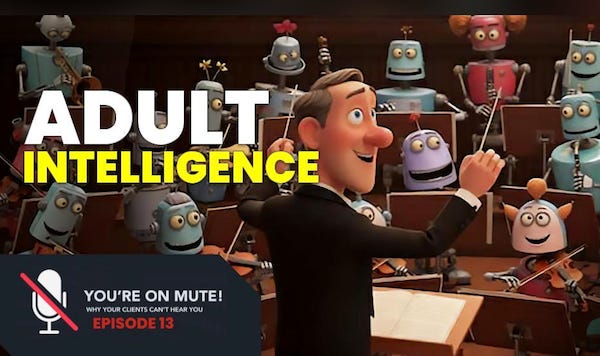
The New York Philharmonic orchestra has over a hundred of the inarguably finest, most talented, and highly-trained musicians in the world. Yet next season, celebrated Venezuelan conductor Gustavo Dudamel will be in front of those musicians, waving a small white stick. Why do players at this level need a conductor? For the same reason, artificial intelligence needs adult intelligence: to provide those things, the players themselves can’t.
The conductor sets the tempo, cues entrances, and synchronizes complex passages to prevent chaos, especially in intricate works like those of Stravinsky or Mahler. Your messaging needs to weave a compelling narrative. AI may assist with the parts, but you need a conductor. The conductor shapes the music’s artistic vision, provides leadership and communication, hears the entire orchestra and makes the necessary adjustments, and manages the scale of your “symphony”.
AI for Speed, Humans For Soul
The bottom line is: your marketing needs an adult at the table. Robots may be fast, but adults are smart. Speed only results in more of the same noise you’re trying to rise above. Being smart creates stories that resonate and inspire action because strategy isn’t just a spreadsheet filled with feelings.
The uber-nerds at MIT authored a position paper that supports this vision, promoting what they called “human-agent systems”. They mentioned that the “most promising future for AI is not in systems that take over human roles, but in those that enhance human capabilities through meaningful partnership.”
That kind of partnership means knowing where machines shine and where they stumble. Machines excel at pattern recognition, data processing, and repetitive tasks. Humans shine at intuition, nuance, irony, empathy, and knowing when to stop talking. You don’t need a machine to feel the gut punch of a missed opportunity or the quiet satisfaction of a job done right. That’s Adult Intelligence. That’s knowing your audience, understanding your client, and connecting with your market in ways that algorithms can’t simulate, no matter how many data points they digest.
Marketing is not just about transmitting information.
It’s about transferring feelings. It’s the art of saying something that makes someone else care. AI might generate a thousand taglines in a second. But it won’t know which one makes your customer lean forward, nod, and say, “That’s me.” It doesn’t know what your client dreamt about last night or what keeps them awake at 3:00 AM. It’s hard to imagine their childhood or how they feel when their boss walks into the room with a weird smile. These aren’t inefficiencies. These are the soul of storytelling.
If your strategy begins and ends with a prompt and a bot, don’t be surprised if your brand voice resembles a Google translation of a Zoom call from 2020. The best campaigns are founded on clarity and confidence, not convenience. Convenience helps, but it’s not a strategy. It’s tempting to outsource your thinking, but that’s how you end up sounding like everyone else, just faster.
Here’s the irony. All this incredible AI power—its countless variations, relentless productivity, and silicon-based confidence—still relies on you to determine what matters. What problem are you addressing? Why does it matter to the people you serve? And why now? These questions aren’t technical. They’re human. They come from experience, context, and the courage to care enough to ask them.
Use the tools. Embrace the innovation. But . . .
This is not a rant against progress. But don’t mistake tools for talent or speed for substance. AI is a calculator. You’re the accountant. AI is the keyboard. You’re the pianist. AI is the brush. You’re the painter. AI is the orchestra. You’re the conductor. You make it meaningful. You make it matter.
The market is filled with noise. Bots continue to generate endless content, visuals, and promises. Your advantage isn’t more content; it’s better content. It’s strategy with heart, stories with backbone, and messaging that resonates because someone—an adult—made sure it was rooted in the reality of human experience.
A fellow Certified StoryBrand Coach told me that she doubled her income in the first half of this year, solely by rewriting ineffective marketing copy written by AI. That is as real as it gets!
If your messaging lacks clarity, empathy, and direction, it’s not because you don’t have enough AI. It’s because you don’t have enough AI of the adult kind. And if you’re still letting the bots do all the work while your brand drifts aimlessly in the algorithmic soup, then… you’re on mute.
We turn muddled messages into magnetic marketing.
Discover how we can help you cut through the noise, reach the right customers, and keep your pipelines full.
SCHEDULE a 30-minute discovery call, and ask about our special offer for Substack subscribers.
One More Thing
Check out our 2-3 minute YouTube Snarky Summaries. (please LIKE and SUBSCRIBE)
Questions? Please email us at info@thesaltzmangroup.com
Thanks for reading You’re On Mute. Subscribe for free (contributions gratefully accepted) to receive new posts and support my work.