You’re driving through a strange small town and realize it’s noontime, and you haven’t eaten anything since that coffee and Egg McMuffin at 6 AM when you hit the road. You think about how tired you are of junk food and how much you’d like a real meal. There are restaurant signs up ahead, but you’re making a blind choice about where to pull in.
On the left side of the road is a restaurant with a few cars in the parking lot. But across the street, on your right, is another local spot with nearly a full parking lot. Only a few parking spots remain, and people are coming and going with smiles and doggy bags.
Do you go left or go right?
You’ll probably choose the “right” option without even thinking about it consciously. But your subconscious is working hard, guiding your actions just like it has for thousands of years. Scientists refer to this phenomenon as “Normative Social Influence,” which is now commonly known as “Social Proof.”
Terminology from 1984
Long before the first signs of Internet-driven Social Proof (LiveJournal in 1999), author Robert Cialdini introduced the term in his influential book, “Influence: The Psychology of Persuasion – 1984). Research shows that people often conform to group behavior, even when they know it is wrong, to fit in (Solomon Asch Conformity Experiments – 1951) and imitate the actions of others, especially in unclear and new situations (Milgram’s Crowd Behavior Studies- 1969).
You were about to turn into the restaurant on the right before you even consciously thought about moving the steering wheel. Why? Because others had already done so. We find comfort in conformity. This brings us (as always) back to story theory, but in a different and complementary powerful way than we’ve discussed in previous posts.
There is something even more effective than telling it yourself — having others tell it for you. Testimonials are a simple yet powerful tool that marketers often overlook. Ken Blanchard wrote about this in “Raving Fans” in 1993. Ten years ago, Peter Shenkman wrote, “Zombie Loyalists: Using Great Service to Create Rabid Fans.” We’ve read the books, but still… no testimonials.
It can be as simple as changing the pronouns in your story. The story is told from the client or main character’s point of view. It includes the same elements: a client with a problem meets a guide with a solution, who offers a plan that is followed and leads to success.
Sometimes, you don’t even have to ask!
When we think of testimonials, we often imagine immediate results and personal interactions. However, they are also valuable over the long term in a B-to-B context. In the summer edition of “Fast Company,” Rob Walker recently reported that shortly after becoming CEO of Starbucks, Brian Niccol spoke up during an earnings call. He told everyone that they were “Bringing the Sharpies back to their baristas to allow them to put that additional human touch on every coffee experience” by writing each customer’s name or an inspiring note on their cup.
In StoryLand (where I live) and beyond, that’s called a “two-fer.” Niccol was sharing HIS company’s story, but the comment didn’t go unnoticed at $7.6B Newell, the maker of Sharpies. They weren’t even aware of the statement, but they started receiving congratulatory messages from all over. Such is the power of testimonials.
Be intentional
Innovative companies recognize that testimonials don’t happen by chance—they are cultivated. They proactively seek them out, shape them, and strategically share them across channels to build credibility and establish an emotional connection with their audiences.
Why do they take those actions? Social Proof! We want to go where others are going. We want to buy the brands our peers favor. We trust what others trust. We follow the crowd to feel safe. We assume popularity equals quality. We seek validation before taking action. We copy what seems to work for others.
Seven real-world examples you can apply to YOUR marketing.
Take Basecamp, for example. Instead of merely gathering generic quotes, they ask users to provide detailed feedback on how their project management software improved communication and reduced chaos. Then, they prominently showcase these testimonials on their website, including names, company affiliations, and even photos. This adds authenticity and transforms satisfied customers into advocates.
Or consider Slack, which features customer stories in blog posts and videos that highlight specific use cases. One notable example is how IBM used Slack to connect 350,000 employees worldwide. By allowing clients to share their challenges and successes in their own words, Slack demonstrates flexibility and influence in ways no standard feature list ever could.
HubSpot has a dedicated section on its website for customer stories. They display case studies sorted by industry, company size, and solution used. This makes it easy for potential customers to find someone similar to them… someone who faced similar challenges and succeeded with HubSpot’s help. These stories aren’t just promotional; they offer practical examples of success.
Then there’s Glossier, a brand that started from a beauty blog and turned its most loyal readers into evangelists. They flooded their product pages and social media feeds with real customer photos, comments, and video testimonials. As a result, new customers didn’t just see attractive packaging—they saw someone like them who loved the product. That’s social proof in its most genuine and scalable form.
Some companies, like Casper Mattresses, have built their entire reputation on user reviews. With no physical showrooms at launch, they relied heavily on testimonials, which became the brand’s main sales tool. Verified buyers shared how the mattress eased their back pain or improved their sleep, and these stories proved more persuasive than any marketing campaign could be.
Salesforce collects testimonial content during annual customer success events, such as Dreamforce, and then turns those snippets into YouTube videos, sales materials, and social media clips. They don’t just ask, “What did you like about our product?” Instead, they encourage stories of change: “What couldn’t you do before that you can now?” or “How did your team change because of us?”
The most innovative brands even tie testimonials to measurable results.Monday.com doesn’t just say, “Our customers love us.” They show data—such as hours saved, productivity boosts, and quicker task completion—directly from user stories.
A Crucial Part of Your Brand Story
These companies view testimonials as a crucial part of their brand story, not just optional extras. They don’t wait for positive feedback to come to them. Instead, they ask the right questions, carefully craft the stories, and focus on the hero: the customer. They know that it is more powerful to have others tell the story. It is social, and it is proof. It is great strategy.
We turn corporate babble into buyer bait. Learn how we can help you cut through the noise, reach the customers you want, and keep your pipelines full.
Check out our 2-3 minute YouTube Snarky Summaries. (please LIKE and SUBSCRIBE)
Questions? Please email us at info@thesaltzmangroup.com
Fireworks, Freedom, and Finding Your Voice
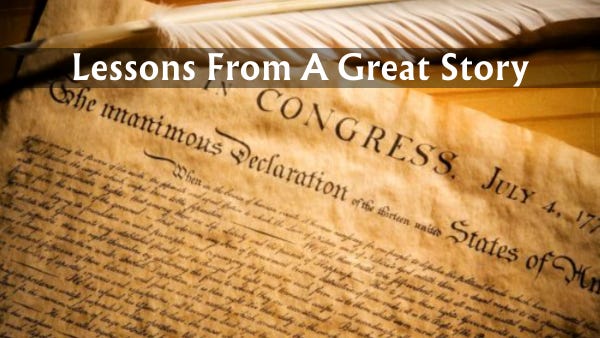
The Declaration of Independence and the leadership of the Second Continental Congress offer timeless lessons in creating narratives that unite, inspire, and celebrate shared victories.
This dynamic unfolded during the founding of America. The colonies emerged as heroes fighting for independence. The Second Continental Congress acted as their guide, providing leadership, strategy, and ultimately drafting a document that unified and inspired them: the Declaration of Independence.
Businesses that learn to use story theory can create emotional resonance as memorable and moving as fireworks in the night sky, erupting in breathtaking blooms and booms of red, white, and blue.
The Declaration of Independence: A Master Class in Story
Drafted in 1776, the Declaration of Independence wasn’t just a legal document — it was an incredibly effective story.
It articulated:
The stakes: freedom vs. continued oppression.
The conflict: unjust British rule.
The vision: a new nation built on liberty.
It turned separate colonies into a cohesive force, much as a compelling client story can unite internal teams, partners, and customers around a client’s success.
Why Storytelling Works
Storytelling is central to human communication and has a particularly profound impact in business. Instead of concentrating on selling products or showcasing expertise, story-driven companies emphasize their clients’ journeys.
Story theory is based on what is commonly referred to as the “hero’s journey” framework.
The client is the hero, striving to overcome a challenge.
The business is the guide, offering tools, wisdom, and encouragement.
Businesses today can adopt a similar approach. By crafting narratives that showcase their clients’ challenges and successes, they forge a strong connection that fosters loyalty and trust.
For example, a marketing firm could tell the story of a small business that breaks free from obscurity to become a market leader. Similar to the colonies, the client’s story revolves around struggle, determination, and ultimate triumph, with the business acting as their guide.
Clients as Heroes
In every great business story, the client must take center stage.
Just as the American colonies sought independence from British rule, your clients are pursuing their own goals, whether that’s growing a business, launching a new product, or gaining customer loyalty.
Consider Anna, a small bakery owner who struggles to compete with large chains. A marketing firm helps her create a compelling campaign that triples her sales. In the firm’s storytelling, Anna, not the agency, is the hero. Her grit and growth take center stage, while the firm’s role is to be a guide and supporter.
Techniques like empathetic listening and developing solutions tailored to each client’s needs support this narrative. Clients should feel like revolutionary heroes, empowered and celebrated for their victories.
The Business as Guide
The Second Continental Congress didn’t engage in battles, but it led the colonies to victory. It offered leadership, strategic vision, and the unifying language of the Declaration of Independence.
Additionally, your business should serve as a guide in client stories. Offer the tools, the path forward, and the encouragement necessary for them to reach their goals, without overshadowing their accomplishments.
For example, a tech company assisting Sarah’s Boutique with its transition to e-commerce should center its storytelling on Sarah’s journey. With a new platform and coaching, Sarah tripled her online sales. What is the tech company’s role? Behind the scenes, providing support, insights, and mentorship.
This positions the business as a force for empowerment, similar to Congress leading the colonies.
Celebrating Client Wins
The colonies celebrated milestones such as the victory at Yorktown with public festivities. The 4th of July itself represents a grand celebration of that triumph.
In business, sharing client success stories through case studies, social media, videos, or press releases creates a similar impact and increases market trust. A consulting firm that helps a client increase revenue by 50% should highlight that story, placing the client front and center.
Like fireworks, these celebrations illuminate shared achievements, reminding everyone that success is most significant when shared.
The Essential Role of Struggle
Struggle is what makes a story compelling. The colonies faced overwhelming odds: taxation, military threats, and internal divisions. That’s what made their eventual victory so significant.
Business stories are no different; it’s the struggle that captivates us. Without it, there’s no narrative arc.
Imagine a startup navigating a competitive market with the assistance of a business coach. The challenges, setbacks, and determination are what make the eventual success resonate with audiences.
The example set by the colonies teaches us that hard-won victories are the ones worth celebrating and are the ones that endure.
The Stakes Must Be Clear
Without stakes, there is no story. The colonies risked everything in their quest for freedom. In business, your clients also face real stakes: staying competitive, growing revenue, or avoiding failure.
By highlighting these stakes, you create urgency and meaning in your stories. A financial advisor who helps a client move from deep debt to financial stability creates a compelling narrative that resonates with others facing similar challenges.
The 4th of July reminds us that without struggle and risk, triumph loses its meaning. Could you incorporate those stakes into your client narratives?
The Power of Shared Effort
The Second Continental Congress didn’t fight on the front lines, but it played a crucial role in uniting and guiding the colonies. The Declaration of Independence provided them with a common voice and vision.
Modern businesses can draw a direct parallel: you don’t do the work for your clients, you empower them to succeed. You equip them, encourage them, and provide them with the tools to shine.
The 4th of July reminds us that when leaders and heroes collaborate, the outcomes can be extraordinary.
Storytelling as a Marketing Multiplier
When you share compelling client stories, you not only celebrate current successes but also attract new business.
A fitness app that showcases a customer’s transformation from sedentary to marathon-ready not only celebrates that client’s achievement but also inspires others to take action.
The Declaration’s bold language wasn’t just for King George; it served as a rallying cry. Similarly, your public client stories should inspire potential customers to envision their journey to success, with your business as their guide.
A Call to Action
Businesses today have a powerful opportunity to apply the timeless lessons of America’s founding story. Embrace story theory:
Make your clients the heroes.
Take your place as the guide.
Celebrate every win like it’s a firework in the night sky.
Listen to your clients. Craft their stories with care. Share them boldly and proudly.
The Declaration of Independence united a nation. Your client stories can unite your brand with your audience.
The Enduring Power of Story
The Declaration of Independence continues to inspire more than two centuries later. That’s the power of a great story.
Businesses can create equally lasting narratives by celebrating client successes. Every milestone, whether a store expansion, a product breakthrough, or a brand refresh, deserves to be spotlighted.
When you honor these wins through powerful storytelling, you build trust and loyalty that endure long after the project ends.
Lighting Up the Sky
On the 4th of July, as fireworks explode in celebration of freedom hard-won, remember that shared victories shine brightest.
Your clients’ successes are your fireworks. Light them up through storytelling — and let their brilliance inspire new journeys, new wins, and new partnerships to come.
Happy Birthday, America!
Questions? Please email us at info@thesaltzmangroup.com
Let’s be blunt: if you’re doing all the talking in a sales conversation, you’re doing it wrong.
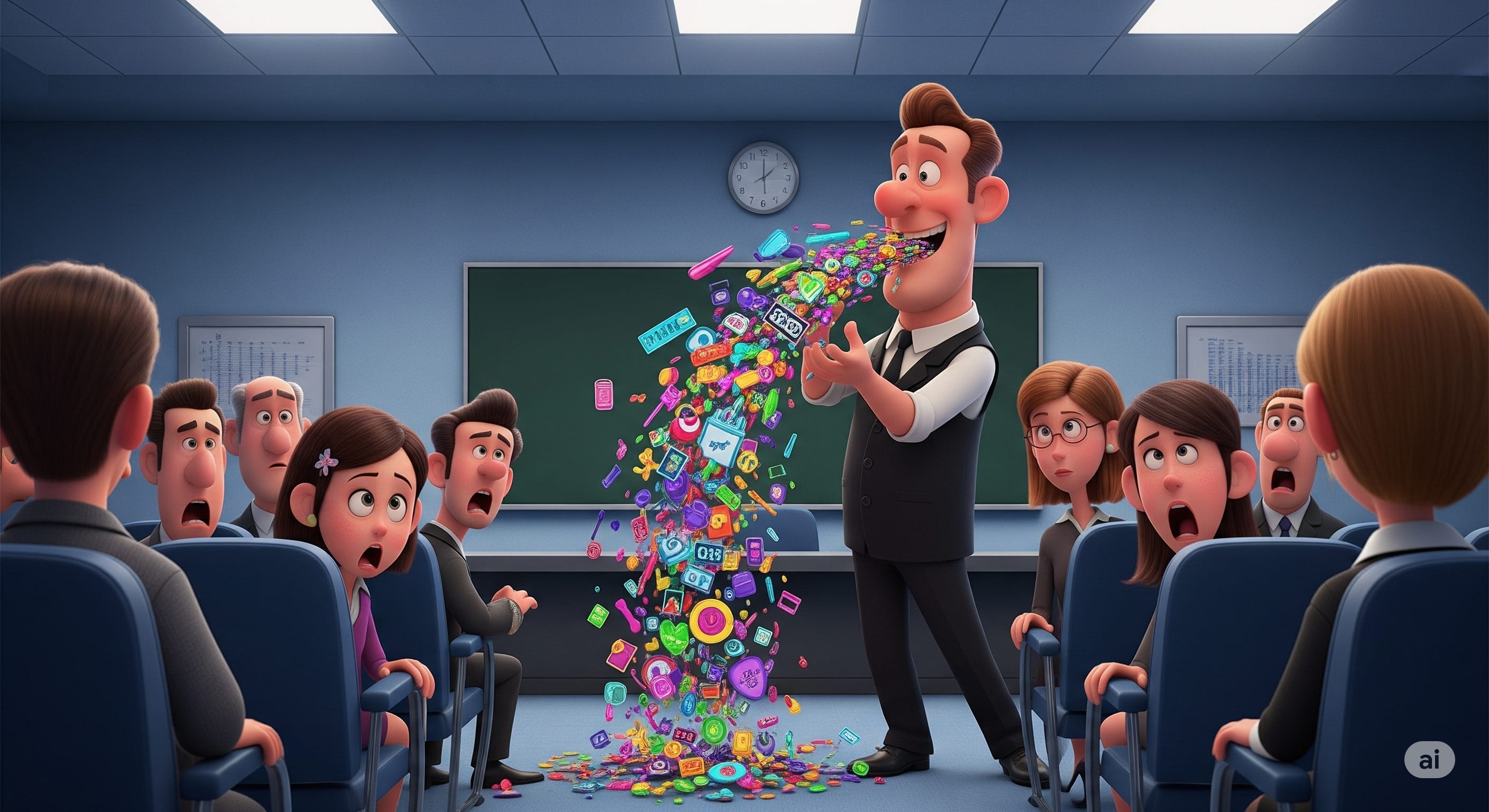
In the rush to impress, persuade, or close the deal, many professionals fall into the trap of what’s lovingly called “show up and throw up.” It’s not as gross as it sounds—unless you’re on the receiving end. This phrase describes the common sales mistake of walking into a conversation and immediately unloading every feature, spec, and benefit on the table as if you’re trying to win a Guinness World Record for Most Words in a Meeting.
Instead of fostering connection, this creates confusion. Instead of encouraging engagement, you get silence. It’s like giving someone a firehose when they just asked for a sip of water.
What “Show Up and Throw Up” Really Means
Imagine this: a salesperson walks into a room, launches into a 20-minute monologue, and never pauses to ask a single question. Or you land on a website so cluttered with jargon, bullet points, and hype that you forget why you were even interested.
This is classic “show up and throw up.” It’s what occurs when a company leads with their product rather than the customer’s problem. It’s a one-sided performance masquerading as a conversation.
As Marcus Sheridan reminds us in They Ask, You Answer, if you don’t show it, it doesn’t exist. And if you overshow it, it might as well not exist either, because nobody’s paying attention anymore.
Why Dumping Features Doesn’t Work
You might believe that listing every benefit of your product or service demonstrates intelligence and thorough preparation. But here’s the truth: nobody wants to hear everything. They want to hear what matters—to them.
1. It Overwhelms People
When you present an overwhelming amount of information, you trigger what psychologists call “decision fatigue.” Too many choices and excessive data paralyze people. They tune out, postpone decisions, or completely ignore you.
2. It Ignores Their Story
Donald Miller’s StoryBrand framework (based on thousands-of-years-old Story Theory) teaches that your customer is the hero—not your product. If you talk nonstop, you’re taking the hero’s place. That’s not your role. Your role is to be the guide, the Yoda, the Dumbledore. Heroes don’t need a lecture—they need assistance on their journey.
3. It Undermines Trust
Modern buyers are skeptical. Research shows that 70% of the buying decision is made before a prospect even reaches out. So, when they finally talk to you, they’re looking for clarity, not noise. If you’re dodging real questions like pricing or comparisons and just rattling off features, you come across as evasive.
Flip the Script: Talk With, Not At
So how do you resolve this? It’s easy. Turn the conversation around. Instead of talking at people, converse with them.
1. Start with Their Needs
Don’t start with your product. Start with their problem. Ask questions like, “What’s holding you back right now?” or “What would success look like for you?” You’ll instantly learn more than you could ever assume.
2. Be Transparently Helpful
People value honesty. Address the difficult questions—like “How much does it cost?” or “What’s the downside?” Sheridan’s pool company famously published an article titled “How much does a pool cost?” and attracted over a million unique visitors. Why? Because they voiced the unspoken concerns. Do that, and people will trust you.
3. Use Clear, Story-Based Language
Forget features. Talk about outcomes. Instead of saying, “Our platform integrates with 14 systems,” say, “You’ll spend 10 fewer hours a week manually entering data.” That’s a story. That’s what people remember.
The 80/20 Rule for Client Conversations
Here’s a golden rule: 80% of the conversation should focus on the client, while only 20% should revolve around your product.
This balance shifts the dynamic, transforming you into a partner rather than merely a pitch machine.
A Quick Oversharing Checklist
Worried you’re still oversharing? Here’s a checklist to gut-check your messaging:
– Is the customer’s problem clear?
If not, start there.
– Are you focusing on one solution, not all of them?
Less is more.
– Is the language plain and simple?
No one’s impressed by buzzwords.
– Have you tackled the scary stuff?
Talk about pricing, drawbacks, or comparisons. If you don’t, Google will. And Google isn’t on your payroll.
– Do you have one clear call to action?
Not three. One.
– Can you say it all in 30 seconds?
If not, trim it.
Stop Performing. Start Guiding.
“Show up and throw up” is just bad manners in disguise. It’s loud, selfish, and unhelpful. You wouldn’t do it at a dinner party, so don’t do it in your marketing.
Both Marcus Sheridan and Donald Miller agree: the companies that win are those obsessed with their customers’ fears, questions, and desires. They listen, respond, and guide.
So, stop the monologue and start the conversation. When you do, you’ll stop sounding like a sales pitch and start sounding like the solution. And that, my friends, is the difference between being ignored and being indispensable.
Questions? Please email us at info@thesaltzmangroup.com
Video dominates the digital landscape. This year, it is expected to account for 82.5% of all internet traffic, and 89% of consumers want more from the brands they love and the brands that interest them. So it is no surprise that 91% of businesses utilize video, and 95% of marketers consider it essential to their strategy.
But raw footage alone doesn’t suffice. To stand out, brands must harness storytelling—the secret sauce that transforms video from noise into emotional connection. By following a proven story framework, your videos can captivate audiences, build trust, and drive action. This article explores why video storytelling is compelling and how you can use it to fuel your brand.
The Power of Video
The figures are staggering:
YouTube experiences 14 billion visits each month and has 2.5 billion active users.
78% of consumers prefer short videos for learning about products, compared to only 9% for text and 5% for ebooks.
Eighty-two percent of consumers say video influenced a purchase decision.
AI tools and smartphones have made video creation easier than ever. Sixty-two percent of businesses produce videos in-house, and fifty-one percent use AI to streamline production. The result? High-quality video is now accessible to brands of any size.
However, accessibility alone won’t drive ROI. It’s storytelling that turns video into marketing rocket fuel.
Why Storytelling Matters
Humans are hard-wired for stories, and they have been for thousands of years. Storytellers were historians. Even in ancient times, the story was the method used to convey and make history memorable.
A compelling story sparks emotion, fosters connection, and drives action. In a sea of content, stories enable your brand to cut through the noise.
Consider your video not as a pitch, but as a mini-movie where your customer is the hero. Organize your content with seven simple yet powerful elements, which have been the fundamental components of stories for thousands of years. In earlier newsletters, we have talked about them for print, but they are equally (or more) valid for making your videos impactful.
Main character (your audience)
Want/Need (their desire)
Guide (your brand)
Plan (how you help)
Call to Action (what to do next)
Success (what winning looks like)
Failure (what’s at stake if they don’t act)
Indeed, there is a lot of nuance and understanding behind each of these components, but here’s an overview of how this works in practice:
1. Make Your Audience the Hero
Your customer, not your brand, is the main character in the story. Example: Illustrate a small business owner struggling to attract customers. At this stage, no one cares about the features of your product.
Authenticity is crucial—91% of consumers say video quality affects trust. Polished, relatable videos resonate best.
2. Tap Into Their Desire
The main character’s desire drives the story. Videos should convey what the main character wants—whether it’s more customers, a better experience, or greater efficiency.
Grab viewers quickly: you have just 8 seconds before most lose interest. Highlighting the customer’s desires keeps them engaged.
3. Position Your Brand as the Guide
Your brand is not the hero; it’s the trusted guide that helps the hero succeed.
For instance, a software company demonstrating how its tools streamline operations is more engaging than just a product demo. According to 88% of marketers, video enhances product understanding—leverage this.
4. Present a Clear, Simple, Digestible Plan
Good guides provide clear next steps. Three or four. Don’t overwhelm. Simplify complex processes into straightforward paths that viewers can follow.
Example: “Use our platform to create ads in three easy steps.” How-to videos have the highest watch times and drive action—65% of executives visit a vendor’s site after seeing such a video.
5. Prompt Action
Every video should include a direct, clickable, or easily achievable Call to Action (CTA). Without one, even the best story can fizzle. You might be surprised at how often the Call to Action is missing in action!
Effective CTAs: “Book a demo,” “Start free trial,” “Shop now”, convert viewers into customers. In longer videos, CTAs positioned at the end achieve a 65% conversion rate.
6. Paint a Picture of Success
Demonstrate what success looks like. Highlight satisfied customers, flourishing businesses, and positive results.
Testimonial videos stand out here—39% of marketers prefer them, and 84% of consumers are encouraged to buy after viewing success stories. For example, a bakery bustling with customers after utilizing your service illustrates the benefit clearly.
7. Highlight the Stakes
Every good story needs tension. What occurs if the viewer doesn’t take action?
Contrast failure (lost sales, stagnant growth) with success to create urgency. Short videos illustrating these stakes are highly effective—66% of consumers find this approach engaging.
Video’s Built-In Advantages
Beyond storytelling, video offers unparalleled reach and influence:
Seventy-eight percent of companies add captions to improve accessibility.
79% of consumers watch on smartphones; vertical formats lead to 10–20% higher conversions.
Short-form videos provide the highest ROI at 21%, and 93% of marketers report a strong ROI from video overall.
Producing content is easier than ever. AI tools and smartphones allow even small businesses to create professional-looking materials. The playing field has never been more equitable. If the story is compelling, viewers won’t even notice that you aren’t Jordan Peele or Quentin Tarantino.
The Emotional Edge
Video storytelling provides an emotional advantage that text and static ads cannot match.
62% of consumers value authenticity over AI-driven personalization. A story-driven video showing a customer’s journey from struggle to success humanizes your brand and fosters trust. The emotional connection keeps your brand top-of-mind and drives conversions.
Why Story-Driven Video Wins
Video dominates marketing because it works:
92.3% of internet users watch videos.
YouTube is used by 90% of marketers.
TikTok, the rising star, is seeing a 27.64% jump in marketing investment.
But it’s storytelling—not just video—that distinguishes great brands from the rest. Structured storytelling transforms raw footage into content that captivates, connects, and converts.
Ready to Ignite Your Brand?
With 95% of marketers prioritizing video in 2025, the competition is intense. Brands that excel in storytelling will lead the pack.
Lights. Camera. Impact, baby! (That’s how those movie people speak.)
Questions? Please email us at info@thesaltzmangroup.com
In the ever-noisy world of modern marketing, it’s easy to assume that having the right product is enough to win attention, engagement, and ultimately, sales. But in reality, messaging is everything. What you say matters—but how you say it might matter even more.
One of the most iconic examples of this principle in action comes from a brand synonymous with sleek design and customer obsession: Apple. Their keynotes are masterclasses in persuasive communication, and a deep dive into their methods reveals why their words hold such power.
Apple doesn’t just sell a product—they sell an experience.
From the moment they announce a new device, they’re not pushing specs; they’re crafting a feeling. That emotional resonance is what allows them to charge a premium. Consumers aren’t just buying a phone or a laptop; they’re buying into a lifestyle, a story, and a brand that understands them.
In fact, Apple keynotes consistently rely on a small set of highly persuasive words: Incredible, Amazing, Beautiful, Simple, Fast, Powerful, Best, New, Innovative, and Magical. Each of these words appeals to emotions and expectations, promising not just a product but a transformation.
But the real magic isn’t just in the words; it’s in how those words are delivered. Apple speakers employ time-tested persuasive techniques that marketers in any field can learn from. Let’s explore ten of the most effective tactics that Apple consistently uses to elevate its message.
1. The Rule of Three Apple often presents features in threes: “Thinner, Lighter, Faster.” This structure feels complete, rhythmic, and easy to remember.
2. Clear, Visual Storytelling Every product is embedded in a story. Apple doesn’t sell features; they sell solutions to problems you didn’t know you had.
3. Simplicity in Language Apple avoids technical jargon, choosing instead to use everyday language. This approach makes their message accessible to everyone, not just tech enthusiasts.
4. Strategic Pausing A dramatic pause before revealing a major announcement—like the classic “One more thing”—builds suspense and captures the audience’s full attention.
5. Contrast and Before/After Framing Apple illustrates what your life was like before their product and how it will improve afterward. It’s not about the product; it’s about you.
6. Audience Inclusion Phrases Like “You’re going to love this,” engage the audience in the story. It’s not about the product—it’s about what the product signifies for them.
7. Meticulous Visual Design Their slides are clean, elegant, and minimalistic. Each slide presents one idea, avoiding bullet-point overload.
8. Credibility Anchors Brief statistics, awards, or third-party endorsements foster trust without being overwhelming.
9. Magical Product Demos Live demonstrations showcase the product in ways that feel effortless and often surprising.
10. The “One More Thing” Surprise This signature move creates an emotional high point, making the presentation feel more like an experience rather than a sales pitch.
These techniques are powerful, but they truly shine when paired with intentional problem/solution framing. Apple excels at identifying problems that their users may not have even articulated yet, then swooping in with elegant, desirable solutions.
Consider a few recent keynote examples:
Battery Anxiety Problem: The constant need to recharge older iPhones. Solution: The iPhone 15 Pro Max with all-day battery life. Apple frames this as freedom, not just more battery—a way to live untethered.
Low-Quality Photos Problem: “Your photos don’t do the moment justice.” Solution: iPhone’s Photonic Engine + Smart HDR 5. They don’t focus on megapixels—they focus on how your memories finally look the way they felt.
Fragile Devices Problem: Cracked screens and bent phones. Solution: iPhone with Ceramic Shield and Titanium design. They convey a sense of durability and elegance, reinforcing Apple’s premium positioning.
Slow Mobile Workflows Problem: Working on the go is cumbersome and slow. Solution: iPad Pro with M2 chip and Magic Keyboard. Here, the iPad isn’t just a tablet—it’s your new office in a sleek, portable design.
Health Tracking Limitations Problem: Your watch can’t keep up with your health goals. Solution: Apple Watch Ultra + watchOS fitness upgrades. It becomes your durable, 24/7 health companion.
Each example illustrates how the same product can be positioned in various ways, but Apple opts to tell stories that focus on the customer experience and portray the product as a hero.
What does this mean for your marketing?
It means that the way you position your product or service is just as important as the product or service itself. You can list features or you can tell stories. You can describe specifications, or you can solve problems. You can communicate benefits, or you can evoke transformation.
If you’re not getting the engagement you want, take a cue from Apple. Audit your words. Simplify your slides. Tell better stories. Create tension. Resolve it. Surprise your audience. And above all, speak their language.
Questions? Please email us at info@thesaltzmangroup.com
In today’s crowded marketplace, a flashy logo, a polished website, or a glossy brochure might grab attention, but they won’t close deals if your message is a tangled mess. Clarity, consistency, and a laser focus on your audience’s needs are the true drivers of revenue—not just decorative flair.
Too many businesses invest resources into aesthetics while overlooking the essence of effective marketing: a message that resonates and converts. If your marketing materials don’t clearly convey what you do, who you serve, and why it matters, you’re not marketing—you’re decorating. It’s time to stop admiring your collateral and start auditing it to ensure it delivers clarity, builds trust, and drives action.
The Clarity Problem in Modern Marketing
Businesses often fall into the trap of assuming their audience instantly understands their value. Vague, jargon-filled headlines like “Innovative Solutions for Today’s Challenges” or “Empowering Your Future” are common culprits. These phrases sound impressive but convey little to a busy customer scanning your website or flyer. Your audience isn’t here to solve a puzzle—they need to quickly understand what you offer, who it’s for, and how it solves their problems. Clarity isn’t about dumbing down your message; it’s about crafting a value proposition so sharp that it’s impossible to miss.
Consider this: the average person’s attention span online is less than 10 seconds. If your homepage or ad doesn’t immediately convey your purpose, you lose the opportunity to engage. A clear message answers three critical questions: What do you do? Who do you help? Why should they care? Without clear answers, your marketing is just noise in an already noisy world.
Why Consistency Builds Trust
Inconsistent messaging is like talking to someone who changes their story every time you meet—you stop trusting them. Your brand operates in a similar manner. If your website promises one thing, your social media posts suggest something different, and your email campaigns adopt a completely different tone, you create friction and undermine confidence. A customer who senses this disconnect will hesitate to engage, let alone make a purchase.
Consistency doesn’t imply robotic repetition or endlessly recycling the same tagline. Instead, it involves establishing a cohesive brand voice, tone, and messaging framework that feels familiar across all touchpoints—whether someone encounters you on LinkedIn, hears you on a podcast, or reads your sales proposal.
A consistent message reinforces your credibility, making your brand appear polished, professional, and trustworthy. It ensures your core value proposition remains recognizable, no matter where or how your audience interacts with you.
The Power of a Marketing Audit
A marketing audit isn’t about tearing your team down—it’s about identifying what’s working and what’s wasting your time, money, and energy. Think of it as a brutally honest friend who points out flaws not to criticize but to help you improve. A thorough audit evaluates every aspect of your marketing ecosystem to uncover gaps and opportunities. Here’s what it should reveal:
Message Mismatch: Are you sending conflicting messages across different platforms? For example, does your website highlight innovation while your social media emphasizes affordability?
Visual Inconsistency: Do your fonts, colors, and logos appear to belong to the same brand, or is your aesthetic a chaotic mix?
Call-to-Action Confusion: Is it clear what you want your audience to do next? Weak or unclear calls to action leave customers feeling stranded.
Customer Disconnect: Are you discussing your own goals and features, or are you focusing on your audience’s pain points and desires?
Value Blur: Can a stranger who visits your website or picks up your brochure immediately grasp why your business is important to them?
An audit compels you to face these issues directly, ensuring your marketing aligns with your business objectives and resonates with your target customers.
Practical Steps to Sharpen Your Message
Refining your marketing message doesn’t require a complete overhaul—just a focused effort to emphasize clarity and consistency. Here are practical steps to get started:
Audit Everything: Review every piece of marketing collateral—your website, social media posts, email campaigns, sales decks, and even printed materials. Document where your messaging seems vague, inconsistent, or disconnected from your audience.
Test with an Outsider: Ask someone unfamiliar with your business—a friend, colleague, or even a stranger—to review your website or key materials for 15 seconds. Can they clearly explain what you do, who you serve, and why it matters? If they can’t, your message needs improvement.
Craft a Compelling One-Liner: Write a single sentence that summarizes your offering, target audience, and main benefit. For example, “We help small businesses save time with affordable, user-friendly accounting software.” Use this one-liner as the basis for all your messaging.
Focus on Pain Points, Not Features: Your product may have a dozen cutting-edge features, but customers only care about how you solve their problems. Instead of touting your software’s “AI-driven analytics,” explain how it “cuts reporting time in half for busy managers.”
Eliminate Ambiguity: If a phrase sounds clever but risks confusion, remove it. Save the witty wordplay for personal projects—your marketing should be direct and impactful.
Your Marketing Clarity Checklist
Use this checklist to kickstart your DIY audit and ensure your messaging hits the mark:
Can someone understand your core offer in under 10 seconds?
Is your target audience clearly defined and directly addressed in your materials?
Are your visuals—fonts, colors, logos, and imagery—consistent across all platforms?
Do your materials focus on your audience’s problems rather than your own achievements?
Is your call to action clear, specific, and easy to find on every platform?
Does your brand’s message feel cohesive, whether it’s on your website, social media, or email campaigns?
The Value of an Outside Perspective
As we pointed out in last week’s newsletter, when you’re immersed in your brand day in and day out, it’s difficult to spot the flaws. As the saying goes, it’s hard to read the label from inside the mayonnaise jar. You might think your messaging is clear, but to a first-time visitor, it can be a confusing jumble. That’s why even the most successful companies bring in outside experts to audit their marketing and provide an objective perspective.
An external audit cuts through internal biases and delivers actionable insights quickly. It’s not about brainstorming new ideas; it’s about refining what you already have to make it work harder. A fresh perspective can identify inconsistencies, clarify your value proposition, and ensure your messaging aligns with your audience’s needs.
Take Action Now
Don’t let unclear or inconsistent messaging sabotage your sales. A clarity audit isn’t just a nice-to-have—it’s a crucial step to ensure your marketing drives results. Whether you tackle it yourself with the checklist above or enlist outside help, the goal remains the same: a message that’s sharp, consistent, and impossible to ignore.
Questions? Please email us at info@thesaltzmangroup.com
We want to believe we make logical, reasoned purchasing decisions. We want to believe that, but we would be wrong. In reality, the process that leads to “buy now” is rarely grounded in spreadsheets or specs. It’s driven by emotion, intuition, and instinct, often shaped before logic even enters the conversation.
That disconnect comes up repeatedly in our work with clients. Many of our initial conversations start with a frustrated lament: “I spent a TON of money on marketing, and it didn’t do anything for sales.” So we ask, “What was your message?” The room falls silent. Blank stares surround us. Sometimes, there’s a sheepish shrug. Rarely, if ever, does anyone have a clear answer.
It’s not that they aren’t smart. They are. (Our clients are like our children – they are all brilliant!) But no one ever taught them the psychology behind effective messaging. Instead, they rely on what seems logical: feature lists, impressive specs, or glowing self-praise about the team. But here’s the thing: no one cares.
But buyers aren’t robots; they’re human. Humans make decisions based on emotion first, then justify them with logic.
Why Your Marketing Efforts Are Failing
If your marketing isn’t moving the needle, chances are you overlooked the emotional groundwork. You built the campaign, wrote the copy, and paid for ads *before* understanding how your customer defines their needs. This results in content that sounds good to you but falls flat with your audience.
In our Story-Theory-guided framework, we focus on addressing three critical questions about your prospect:
1. What is their external problem? 2. What is their internal frustration? 3. What philosophical reason do they have for believing the problem shouldn’t exist?
Only when we answer these can we create a message that breaks through the noise.
Tip #1: Understand the Problem Behind the Problem
Imagine you sell CRM software. The external problem is obvious: their current CRM is cumbersome and ineffective. But what’s *really* happening?
– Internally, they feel overwhelmed, behind, and perhaps even embarrassed that their team isn’t using the tools correctly. – Philosophically, they believe that with all the tech options available, it *shouldn’t* be this hard to manage sales leads.
When your message conveys this complete picture, your buyer feels acknowledged. That’s when trust begins.
A Bit of Brain Science
Let’s take a detour into neuroscience. Warning: this may challenge everything you believed about decision-making.
We like to think our rational mind (hello, prefrontal cortex!) drives our choices. However, research from Nobel Prize-winning psychologist Daniel Kahneman and his partner Amos Tversky suggests otherwise. Their studies indicate that most decisions are made quickly and emotionally, governed by areas of the brain such as the amygdala, often referred to as our “lizard brain.”
That’s the same part of the brain responsible for fear, pleasure, and reward. It reacts first; logic comes later—often just to support what we have already emotionally decided.
So, no, logic didn’t buy that sports car. Emotion did. Logic just helped you explain to your spouse why it was a “wise investment.”
The Psychology of Your Prospect: A Quick Checklist
Before building your next campaign, consider the following questions:
1. What keeps your customers up at night? – Not just the practical matters. What are they *feeling*?
2. What does success look like to them emotionally? – Less stress, more confidence, or a sense of control?
3. What internal dialogue occurs before they speak to you? – Are they blaming themselves? Are they worrying about how they are perceived?
4. What belief do they hold about how the world *should* work? – Explore that. It serves as a powerful philosophical anchor.
5. What words do *they* use to describe their problem? – Not your jargon. Use their words. That’s your messaging goldmine.
Tip #2: Develop Your Message from the Inside Out
Once you grasp your client’s emotional landscape, you can start crafting a message that resonates. Here’s how:
1. Lead with empathy — Show that you understand their frustration. 2. Position your offer as a guide — You’re not the hero; they are. 3. Paint a picture of success — Help them visualize life after the solution. 4. Use emotion-rich language — Forget about features. Speak in feelings.
That may sound somewhat like therapy, and in some respects, it is. You’re assisting prospects in recognizing and articulating their struggles, while providing them a credible path forward.
Why This Method Is Effective
People don’t just buy products or services; they buy outcomes, relief, transformation, and feelings.
They don’t want a faster CRM; they want to stop feeling like they’re drowning in spreadsheets. They don’t want another consulting package; they want to stop losing sleep over their business. They don’t want a new website; they want to feel proud when they send someone to their homepage.
If your message can evoke those feelings before they even become a client, you’re halfway to making the sale.
Tip #3: Test and Listen
Messaging is not a one-and-done process. It’s iterative and evolves.
Test headlines. Track engagement. Pay attention to how prospects articulate their pain points during sales calls or support tickets. Your future content should reflect your insights.
Don’t assume you got it right the first time. Think of it as you being 80% right and stay curious about the other 20%.
So, what’s next?
If you’ve spent thousands on marketing that didn’t move the needle, it’s not your product; it’s your message. Fixing it isn’t just about better copy; it’s about understanding your buyer at a deep, emotional level—and telling a story that reflects what they truly need.
Questions? Please email us at info@thesaltzmangroup.com
Did you ever notice how casual conversations are often the start of things that make you say, “hmmmm” (thanks, Arsenio)? It happens to me all of the time. Someone will make a random comment that sticks like a jingle you didn’t ask for but now can’t forget. Yeah… me too!
That’s the funny thing about ideas—they don’t always arrive in your inbox or appear in a brainstorming session without warning. Sometimes, they sneak in through the side door, wearing sneakers and cracking jokes. And sometimes, what starts as a throwaway remark can become the seed for a powerful truth about your business, especially regarding messaging.
I’ve been working with a startup. They are brilliant people focused on a groundbreaking application of AI to help manage multiple chronic conditions. Due to advancements in medicine, what used to be fatal no longer is. This is beneficial, but it leaves the entire healthcare ecosystem—from patients to payers, and everyone in between—grappling with how to achieve better outcomes, each defined differently by each market segment.
Here’s where things get messy—and interesting.
When survival is no longer the benchmark, the definition of “success” becomes a moving target. For patients, success might mean fewer hospital visits or better quality of life. For providers, it might mean care plan compliance or reduced ER utilization. For payers, it might mean fewer claims. Everyone is playing a different game on the same field, and they are all keeping score in their own way. This brings us to the challenge of creating a clear message.
Miles’ Law (where you stand depends on where you sit) is at work, threatening to turn your message into a choose-your-own-confusion adventure. A startup still trying to find its core constituency complicates this by an order of magnitude. As we discussed in last week’s post, the client is now chasing a fluffle of rabbits. However, this time it isn’t a simultaneous reach to different avatars, but rather the need for a message that aligns with your growth stage.
This isn’t just a startup problem. It’s a growth problem. As your company evolves, your messaging has to evolve with it. Each new stage brings new audiences, new priorities, and new expectations. And each one demands a different message—crafted, tested, and aligned to where you are, not where you were.
Let’s break that down.
Stage 1: Seed At the seed stage, your job is to prove the problem is real—and that someone cares enough to pay to fix it. Messaging here is raw, often scrappy, and focused almost entirely on pain. That’s okay. Your audience is small: early believers and risk-taking investors.
But even here, clarity wins. If you can’t explain what you do in a sentence, you’re already underwater. You’re Baby Yoda—powerful potential, but still mostly babbling.
Stage 2: Startup Now the chaos begins. You’re sprinting to build, test, iterate. The product shifts. The pitch shifts. Everyone has feedback. Everything feels urgent.
This is where companies often try to talk to everyone—listing every use case, feature, and persona. Resist that urge. Choose one audience. Speak their language. Your message should narrow, not expand. That focus is what will guide you through the noise.
Stage 3: Growth You’ve got traction. Customers are arriving. Revenue is increasing. This is the moment to codify your messaging.
You need consistency across sales, marketing, support, and product. You require a playbook that includes concise language, structured benefits, and a clear tone. The founder’s voice can no longer carry everything; the entire company must convey the message.
Think of it like Jedi training. You’ve got the Force—but now it needs discipline.
Stage 4: Expansion This is where messaging gets political. You’re launching new products, entering new markets, and targeting new segments. Now you’re juggling competing priorities: internal alignment and external relevance.
You can’t be a different company for every audience, but you also can’t use one voice for every channel. Personalization and segmentation are essential. You’re not changing what you do—you’re changing how you say it, depending on who’s listening.
Stage 5: Maturity You’ve made it. Brand equity is strong. Recognition is high. But here’s the twist: messaging risk increases now.
Companies at this stage either cling to outdated language or chase trendy nonsense; neither approach works. You need to revisit your message regularly and ask: Is this still true? Is this still bold? Does it still resonate?
Are you still talking like Baby Yoda when the world expects Boss Yoda?
At every stage, messaging must evolve. It should reflect who you are, anticipate where you’re headed, and—most importantly—speak clearly to the people you want to reach next.
So if your story feels stuck, if your pitch sounds scattered, or if you’re talking like a Jedi Master while wielding a plastic lightsaber… pause. Refocus. Get clear.
Because the right message, at the right time, in the right voice? That’s how companies grow up. And how they win.
If this series sounds like something you or your team needs, click the subscribe button so you won’t miss the next one. (Contributions are appreciated, but are optional)
We can help! Drop me a message—ask a question or two. We can help you find and sharpen your voice. info@thesaltzmangroup.com
To schedule a 30-minute discovery call, click HERE
Check out our 2-3 minute YouTube Snarky Summary HERE (please LIKE and SUBSCRIBE)
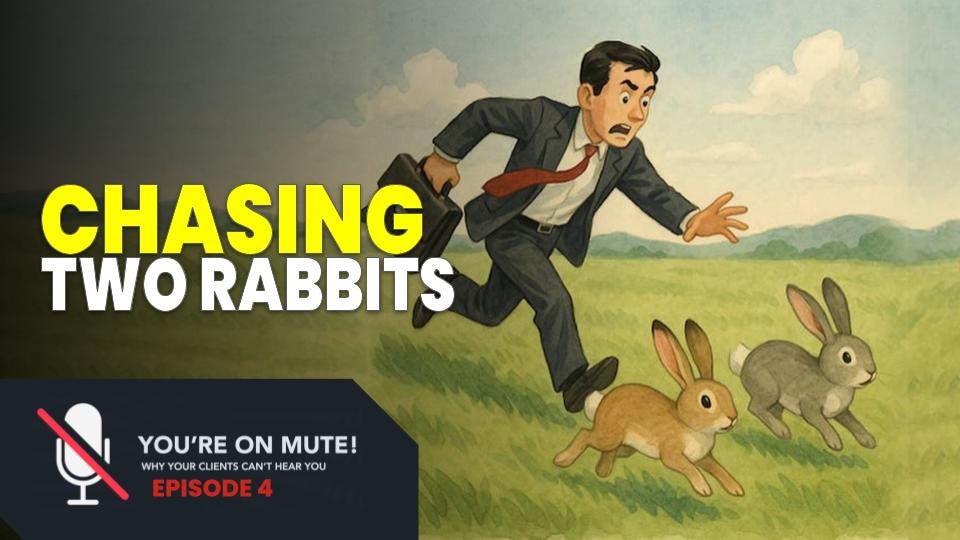
When you live in the South, as I do, you learn many fun (and often instructive) sayings. The first time I heard someone say, “You can’t chase two rabbits,” I must have had an expression that screamed, “Someone translate for the ignorant Yankee!”
My friend explained that it is a nice way to say you must focus on a single objective. If you try to catch two rabbits simultaneously, you will miss bagging either one of them.
It’s the same in messaging and marketing. If you try to market to two different buyers at once with a single message, you will miss both. It is like chasing two rabbits while blindfolded and yelling in two languages.
When we start working with a new client, we audit their existing marketing and learn about their business. Then, we take the first step, which is defining the problem our client solves for their prospects. This is unquestionably the most critical component of creating a clear, compelling message—and it is inevitably when the starting gun fires, signaling the start of the multi-rabbit race chase.
And it gets ugly . . . fast!
Our new client quickly realizes that their marketing suffers from what we call “Elmer Fudd Syndrome:
They are chasing wabbits.
Determining the problem they solve has become more challenging. Their current marketing often does an ineffective job of attracting either audience. Somehow, likely as a gradual devolution, they have convinced themselves that they can use some muddled middle message that doesn’t speak clearly to either of their newly discovered constituencies.
This is often a mind-blowing experience for clients with two (or more) different prospects, each of which has a real or perceived (more on this in our next episode) completely different problem they are trying to solve.
Example:
The client is a software company that sells a new CRM with a fantastic feature that automatically sends follow-up emails.
• The sales team thinks: “Awesome! Less busywork, more time to close deals.”
• The compliance team thinks: “Wait—are these emails approved? What about data privacy rules?”
Same solution, two very different perspectives—each group has distinct goals and concerns.
Here’s where it truly begins to unravel. In an effort to appeal to both teams, the company attempts to split the difference. The result? A bland, jargon-heavy homepage that says something like:
“Empowering scalable engagement through automated compliance-aware communication workflows.”
Translation: “We’re not sure who we’re talking to, but we hope one of you finds this interesting.”
No one does.
You know who wins? The competitor who puts a bold headline front and center:
“Sales teams love us because we help them close faster—without ticking off the compliance department.”
Boom. Clear. Specific. Rabbit caught.
Let’s break this down:
When you attempt to use one message to speak to two different audiences, you dilute it so much that it loses all flavor. It’s like making chili that’s part spicy, part mild, part vegan, part meaty. No one’s happy.
We’ve seen this countless times. The CEO wants to address both investors and customers simultaneously. Alternatively, a healthcare company aims to attract both plan sponsors and individual patients with a single campaign. Or—my favorite—the “we serve everyone” approach. That’s code for “we serve no one particularly well.”
Here’s what happens instead when you pick a single rabbit:
1. Your messaging gets sharper.
2. Your marketing becomes more effective.
3. Your sales team gets aligned.
4. You gain trust faster.
And before you ask: Yes, you can serve multiple types of clients. Just not with the same message at the same time. Think of it like having two landing pages, two nurture sequences, or two web sections tailored to each rabbit. You’re not saying different things—you’re saying the right thing to the right person.
That’s not fragmentation. That’s focus.
One of our clients, a fast-growing benefits platform, fell into the dual-rabbit trap. Their homepage attempted to communicate with HR leaders and benefit brokers using a single pitch. HR folks saw the word “broker” and bounced. Brokers thought the tool was for internal teams and tuned out. Once we separated the two paths—each with its own message, problem, and proof—the conversion rate doubled. Not “went up a little”—doubled.
Why? Because people felt spoken to. Understood. Valued.
The human brain is often lazy. It doesn’t want to decode your messaging. If I have to determine whether your solution is for me, I’m already gone. Your prospects aren’t lacking intelligence—they’re lacking time and attention.
So, here’s the takeaway:
If your product or service has multiple buyer personas, provide each of them with their own runway. Don’t force them onto the same landing strip and hope they don’t collide.
Tailor your language.
Customize your visuals.
Adjust your testimonials and proof points.
You don’t need a whole new brand—just message maps and guided content paths that show you understand each rabbit’s worldview.
Otherwise, you’re just Elmer Fudd, chasing wabbits and wondering why you’re still hungry.
Let’s wrap with this simple checklist to avoid dual-rabbit syndrome:
✅ Can you name your top two buyer types—without combining them?
✅ Does each have a different primary concern?
✅ Have you crafted a unique message, value proposition, and CTA for each?
✅ Does your website give each audience a clear path to follow?
✅ Are your sales assets (decks, emails, scripts) tailored by persona?
If you answered “no” to more than one of those, it’s time to pick a rabbit—and catch it.
Because when your message tries to do everything, it ends up doing… nothing.
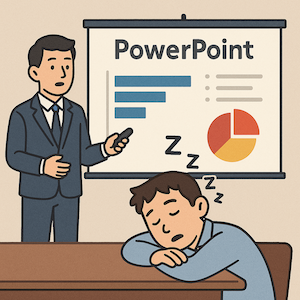
If there’s a more surefire way to kill a sale than a rambling, bloated PowerPoint presentation, we haven’t seen it.
Somewhere along the way, sales teams have forgotten that prospects are humans—not robots who crave 52 slides of features, charts, and company history. They’re people with problems, hoping that someone will come along and say, “Hey, I understand what you’re dealing with—and I’ve got a way to fix it.”
Instead, we get corporate monologues disguised as “sales decks.”
Let’s set the scene: a room (or worse, a Zoom) filled with people who were interested—until slide 4. The presenter has already blitzed through the origin story of their company, introduced everyone on the team (with bios), and displayed the full timeline of feature releases since 2013. Meanwhile, the prospect wonders if they have time to check their email—or fake a power outage.
What Went Wrong?
The presenter fell in love with their solution before acknowledging the prospect’s problem.
And that is the fatal flaw in sales messaging.
We talk about what we do. We explain how we do it. We fill the slides with diagrams, bullet points, and buzzwords. And we forget to do the one thing that makes people listen: show them that we understand them.
By the way, about those bullet points…
You may think “bullet points” are just a formatting tool. But legend has it the name came from people metaphorically pointing guns at presenters whose droning voices and endless bullet lists drained the life out of every room. Whether or not that’s true, we can all agree: most bullets miss the target.
The Human Brain Doesn’t Want a Lecture
It wants a story. It wants a guide. It wants hope.
You’re not just there to share information; you’re there to help someone make a decision—one that’s in their best interest. The PowerPoint isn’t your main character; your prospect is. Your job is to position your solution as the guide that helps them win the day.
Enter: Pecha Kucha
For anyone unfamiliar, Pecha Kucha is a Japanese storytelling format in which a speaker shows 20 slides, each for precisely 20 seconds. This totals 6 minutes and 40 seconds. They use very few words, mostly graphic images. Here is the key: the slides auto-advance, leaving no room to waffle or wander. It is an excellent tool for developing messaging discipline.
Try delivering your next pitch Pecha Kucha-style. It will compel you to distill your message, concentrate on what matters, and eliminate the fluff. You’ll need to be clear, quick, and personable. Ironically, this is the opposite of what most sales presentations do.
How to Cure Your Deck of Death
1. Lead with the Problem – Show your prospect you understand what they’re going through. Be specific. Make them feel seen.
2. Position yourself as the guide – don’t position yourself as the hero. Make the customer the hero and cast your product as the sidekick.
3. Cut the slides by half—then cut them again. If you’re explaining instead of engaging, your deck is doing damage.
4. Use Visuals, Not Text Blocks – If you’re reading your slides, why are you even there? Say less on screen so that people can focus more on you.
5. Practice the Pecha Kucha format— even if you don’t use it live, it’s a great way to refine your message.
6. Learn how to make your presentation WITHOUT ANY SLIDES! You probably don’t know your story well enough if you can’t do that.
Remember: People Buy Clarity
They buy what they understand. And no one understands a 45-minute feature demo that feels like a bedtime story told by a toaster. Simplify and clarify. Then speak directly to the person in front of you—their needs, challenges, and success story waiting to happen.
You don’t need more slides; you need more empathy.
More slides = confusion. And if you confuse, you lose!
We can help! Drop me a message—ask a question or two. We can help you find and sharpen your voice. info@thesaltzmangroup.com
To schedule a 30-minute discovery call, click HERE
Check out our 2-3 minute YouTube Snarky Summary HERE.
There’s a simple, universal rule in marketing and sales:
“If you confuse, you lose!”
It doesn’t matter how beautiful your website is, how catchy your slogan sounds, or how many awards your product has won. If your messaging makes a customer pause—even for a moment—to ask “Wait, what do they do?” then you’ve already lost the sale.
In today’s saturated marketplace, where attention spans are measured in seconds and decisions are made in moments, clarity is the most powerful competitive advantage your brand can have.
Clear Beats Clever—Every Time
Somewhere along the line, marketers got the idea that being clever was the goal. But here’s the truth:
Clever doesn’t convert. Clarity does.
A witty turn of phrase or a metaphor might make your team chuckle in a brainstorm, but if your ideal customer has to work to understand what you’re offering, they’ll bounce.
People don’t buy what they don’t understand.
If someone lands on your homepage and it takes them more than five seconds to figure out what you do, your bounce rate will skyrocket. That’s not because they’re dumb. It’s because the human brain is wired to avoid unnecessary effort.
Why Humans Avoid Mental Effort in Buying Decisions
Our brains are designed to conserve calories. In evolutionary terms, thinking hard used to mean burning precious energy that might be needed to outrun a saber-toothed tiger.
So we developed a shortcut system: we gravitate toward simplicity and avoid mental strain.
In marketing, this means that if your message forces your prospect to think too hard—decoding acronyms, translating industry-speak, or solving riddles—they’ll simply move on to the next brand that’s easier to understand.
They’re not lazy. They’re efficient. And clarity makes the buying decision easier.
Kill the Jargon. Speak Human.
One of the biggest clarity killers? Industry jargon.
These are the terms that might impress your peers but leave your prospects scratching their heads.
Let’s say your homepage proudly declares:
“We leverage data-driven synergies to optimize cross-channel activation and deliver scalable omnichannel ROI.”
That sounds impressive—until you realize your ideal customer just wants to know if you can help them get more leads.
Now compare that to:
“We help businesses get more qualified leads from their marketing—without wasting money.”
Clear. Simple. Customer-focused.
Jargon is a crutch. It gives the illusion of authority while putting distance between you and your customer.
Your goal is not to sound smart. Your goal is to be understood.
Confused vs. Clarified Messaging
Here are two quick real-world comparisons:
Software Company
❌ Confused:
“Our platform delivers integrated digital transformation solutions via a hyper-scalable SaaS ecosystem.”
✅ Clarified:
“A simple software tool that helps small teams manage projects, track progress, and hit deadlines.”
Financial Advisor
❌ Confused:
“We offer holistic wealth planning solutions driven by fiduciary frameworks and diversified portfolio structures.”
✅ Clarified:
“We help families build and protect their wealth so they can retire with peace of mind.”
In both cases, the clarified versions win. Not because they’re simpler, but because they’re clearer. They answer the one question every customer is silently asking:
“Can You Solve My Problem?”
That’s it. That’s the whole game.
Your customer isn’t looking for a vendor or a visionary. They’re looking for someone who understands their problem and can help fix it.
They don’t care about your backstory, your technology stack, or your vision statement—not until they know you can help them.
Every piece of your messaging—website, sales deck, tagline, bio—should pass this test:
– Can someone quickly identify what problem you solve?
– Can they see how your solution makes life better?
If not, it’s time to simplify.
The 5-Point Clarity Checklist
Here’s a simple framework to audit your message and create instant clarity:
1. What do you offer?
Say it plainly. No fluff.
Example: “We design websites for law firms.”
2. Who is it for?
Your ideal customer should feel like you’re talking directly to them.
Example: “Busy parents who want healthy meals fast.”
3. What problem do you solve?
Lead with the pain they already feel.
Example: “Tired of missing leads because your CRM is a mess?”
4. How does it make life better?
Paint the picture of success.
Example: “Save hours each week and finally feel on top of your workflow.”
5. What should they do next?
Be direct. Don’t make them guess.
Example: “Book a free 15-minute call.”
Final Thought: Simplify to Amplify
If you want your marketing to work harder, make your message simpler. Not simplistic—just clear.
Clarity doesn’t mean dumbing things down. It means removing every barrier between your customer and their decision to buy.
Remember: your customer isn’t looking to admire your cleverness. They’re looking for a trusted guide who can solve a real problem.
So next time you’re tempted to get fancy with your messaging, ask yourself:
Would a fifth grader understand this?
If the answer is yes, then congratulations—you’re on your way to winning more business.
Walk into any conference, scroll through LinkedIn, or sit through a few corporate presentations, and you’ll see it right away:
Businesses are speaking. But no one’s really listening.
They’ve got websites with slick designs, social feeds full of “we’re excited to announce” posts, and mission statements packed with buzzwords. But when you ask their audience—prospects, customers, even employees—what that business actually does or why it matters, you’re likely to get a blank stare.
It’s not because their product or service isn’t valuable. It’s not because they’re not trying.
It’s because their message isn’t cutting through.
It’s noise, not signal.
Welcome to the first article in our new series: “You’re On Mute: Why Your Clients Can’t Hear You.”
This series is all about helping businesses fix the most common (and costly) problem in marketing today: a message that nobody hears, understands, or remembers.
Whether you’re a founder, marketer, or sales leader, this is your starting point for building messaging that actually works.
The Symptoms of a Muddled Message
You might feel like you’re communicating all the time—social posts, campaigns, webinars, emails.
But are people responding? Are they getting it?
Here are a few signs your message isn’t landing:
Your team struggles to explain what you do in under 30 seconds.
Your website looks good but doesn’t convert.
You’re constantly “educating the market” but still hearing crickets.
You rely on referrals because your marketing doesn’t work.
You keep trying new tools and platforms, hoping something finally clicks.
Why It’s So Hard to Be Clear
Clarity is deceptively difficult.
Why? Because you’re too close to your business. You know too much. You care about everything.
So you try to explain everything—and in doing so, you lose the one thing your audience actually needed: a clear, focused message.
Here’s the truth: People don’t want a crash course in your offering. They want to know:
“Can you help me solve a problem I care about?”
If your messaging doesn’t answer that fast and simply, they’ll scroll, click away, or forget.
The Real Reason People Aren’t Listening
It’s not that people don’t care.
It’s that their attention is expensive—and your message has to earn it.
We live in the age of short attention spans, infinite content, and constant distractions.
If your message isn’t instantly clear and relevant, people will move on.
As Donald Miller says in Building a StoryBrand:
“If you confuse, you lose.”
Your audience is the hero of their own story. They’re focused on surviving and thriving. If you position your brand as the hero, they tune out.
But if you position your brand as the guide—someone who helps them win the day—everything changes.
From Muffled to Magnetic
Here’s the good news: You don’t need to shout louder. You just need to be clearer.
When your message is focused, relevant, and built around your customer’s needs, your brand starts working with human nature instead of against it.
That’s what we’ll break down in this series.
Here’s what’s coming next in
You’re On Mute:
🔹 How to clarify your message — So your audience can understand what you do in seconds—not after a 10-slide deck.
🔹 How to create a simple, effective story — That turns your messaging from information into inspiration.
🔹 How to build consistency across every channel — Your website, social media, sales pitch, and email campaigns should all say the same thing.
🔹 How to avoid the traps — Jargon, ego, and trying to say everything to everyone will kill your message. We’ll show you what to do instead.
🔹 How to lead with empathy and simplicity — Because clear messaging isn’t just smart—it’s generous.
The Opportunity in the Noise
Here’s the kicker: Most of your competitors are still on mute.
They’re spending on ads, websites, and marketing automation—but they’re skipping the foundational work of clarifying their message.
When you do that work, you immediately stand out.
✅ Sales get easier.
✅ Your marketing starts working.
✅ Your team aligns around a shared story.
✅ Your customers get it.
In a noisy world, clarity wins.
Let’s Turn the Volume Up—Intentionally
This series isn’t about adding more noise. It’s about helping you say the one thing your audience needs to hear—and making sure they do.
You already have something worth sharing.
You already have the voice.
Now let’s make sure the right people hear it.
Remember – if you confuse, you lose!
If this series sounds like something you or your team need, hit the subscribe button to avoid missing the next episode.
Check us out on YouTube for a 2–3 minute Snarky Synopsis – click HERE
We can help!
What’s your marketing/messaging challenge? Drop me a message—ask a question or two. I’d love to help you find and sharpen your voice. info@thesaltzmangroup.com
Want to talk it through? Schedule a 30-minute discovery call: Book here.